
“Let your women keep silence in the churches,” declares Paul in Corinthians 14:34. Catherine Brekus ’85 specializes in hearing the voices of America’s early female religious leaders, nearly lost to history—a casualty of neglect, or sometimes a more deliberate excision from the historical record. Her work has required some sleuthing—finding manuscripts scattered across libraries and antiquarian societies—and deep dives into material history, learning about everything from eighteenth-century medicine to laundry. Always striving for “empathetic engagement with the past,” Brekus easily gets swept up in describing past events. Her voice drops as she describes the revival leader at the center of her most recent book, Sarah Osborn’s World, noting the irony that a “free will person” should be the historian to delve into these fiercely Calvinist writings. In an interview upon winning the 2013 Aldersgate Prize (which annually recognizes works of Christian scholarship), Brekus said that in imagined debates, Osborn has “tried very hard to convince me”—though without success. “I did not like studying history in high school,” the Warren professor of the history of religion at Harvard Divinity School confesses, smiling. “I was always good at it…but the idea is that you memorize a lot of facts, mostly about political history, and what happened when.” When she taught the subject to high-school students for two years, Brekus noticed that textbooks “have this narrative of political events…and then you have this little human-interest thing in a box. That was where the women would appear. My goal as a historian,” she adds, “is to get women out of those boxes and into the main texts.”
Catherine Brekus, Harvard historian, studies women religious leaders
A Harvard Divinity School specialist on women in early America

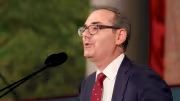
Catherine Brekus | Photograph by Stu Rosner

Catherine Brekus/Photograph by Stu Rosner
You might also like

Why Men Have Worn the Same Black Suits for 200 Years
Chloe Chapin trains her Broadway costume designer’s eye on the history of men’s fashion.
Meet the Harvard Alumni Association’s New President
David Battat promotes alumni engagement.

How CNN’s Abby Phillip Referees Political Debates
The Harvard graduate’s roundtable talk show touches on hot button issues from religion to sex.
Most popular



Explore More From Current Issue

The University is expanding industry ties and investing its own funds to support research, but neither will replace lost federal dollars.

A rare Egyptian mummy case is on display at the Harvard Museum of the Ancient Near East.

The professor and former Harvard College dean is the next president of Harvard Magazine’s Board of Directors