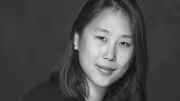
“I like broad canvases—probably too broad most of the time,” says theater composer Michael Friedman ’97. “But I feel it’s better to be too ambitious than not ambitious enough.”
Friedman isn’t likely to be accused of insufficient ambition. This August, a new version of Love’s Labour’s Lost, with his music, opened at the Public Theater’s Shakespeare in the Park series in Manhattan. Eleven days later, previews began for Mr. Burns, a Post-Electric Play, Friedman’s latest work for the “investigative theater” troupe The Civilians, which he helped form as a founding associate artist in 2001. (Ben Brantley of The New York Times wrote of Mr. Burns, “…in the astonishing final sequence, the composer Michael Friedman has devised a fabulous score that turns Britney Spears and Eminem hits into chthonic chorales.”)
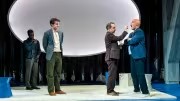
Both productions reflect his attraction to projects cobbled together from disparate, even incongruous, elements. Characters in the Shakespeare play wore everything from tuxedoes to sequined hot pants as they disported themselves around an unnamed contemporary college campus; in Mr. Burns, the survivors of a global cataclysm struggle to recall and ultimately re-enact an iconic episode of The Simpsons that itself parodied the movie Cape Fear.
Friedman, who won an Obie award for sustained excellence in 2007, “has a talent for mixing catchy, up-tempo hooks and smart, searching lyrics,” wrote David Cote in Time Out New York. Take “Populism, Yea Yea!” from Bloody Bloody Andrew Jackson, the Tony-nominated, Drama Desk Award-winning 2010 Broadway effort which reinvented its title character as an emo rock star. Backed by pounding electric guitars and heavy drums, Friedman’s rousing opening number offers lines like “Take a stand against the elite!/They don’t care anything for us!/And we will eat/Sweet democracy/And let them eat our dust!” “Michael has a singular worldview and a singular aesthetic,” says Alex Timbers, who directed both Bloody Bloody and Love’s Labour’s Lost. “He has a real sense of social commentary and politics in his music, and he’s able to marry those with comedy and earnestness. His songs have open eyes.”
The Civilians has achieved renown for shows based on interviews with real people about various social phenomena. “Our mission relates to a need that was being felt in theater, in film, in TV, to make stuff that connected to, derived from, and related to what was happening in the real world,” Friedman explains. “Thus the explosion of documentary and reality and nonfiction work in all these media. Certainly I think our approach of taking these investigative techniques and applying them to music theater is unique.” In The Footprint (2010) portrayed complex neighborhood reactions to the massive Atlantic Yards Development Project in Brooklyn. For some shows, like This Beautiful City (2008), about the growing evangelical movement in Colorado Springs, Friedman has conducted his share of interviews. “We’re trying to understand the community or understand people’s lives in a fuller, richer way,” he says.
Taking a break from Mr. Burns rehearsals at Playwrights Horizons on West 42nd Street, sitting in front of a large window overlooking the Manhattan streetscape, Friedman gestured expansively, his head weaving, his wiry frame shifting back and forth. He’s a lot like his music—voluble, energetic, a lot going on. It’s no accident, perhaps, that his tunes are crammed with notes and, frequently, an overabundance of lyrics. “I think that’s our culture right now,” he declares. “I’d say that we live in a culture not of collage, but of constant visual and aural stimulus. We live in an iPod culture. We have bugs in our ears and we’re wandering through the world and songs are playing.”
Friedman arrived at Harvard from Germantown Friends School in Philadelphia and studied music composition with Bernard Rands and Mario Davidovsky; he cut his performing teeth with the Collegium Musicum, the Harvard Radcliffe Contemporary Music Ensemble, and the Harvard-Radcliffe Dramatic Club (HRDC). Upon graduation, he felt ready to tackle anything. “One thing Harvard lets you do is make your own mistakes, which is very helpful,” he reflects. “It lets you choose the wrong classes and it lets you fail if you’re going to fail…. When I got out of school, I was much more confident coming to New York and feeling that I knew how to knock on doors and force myself into things that otherwise I wouldn’t have.”
Much of that confidence, too, was learned under Elizabeth Swados, who in Friedman’s senior year was an artist in residence as part of the HRDC’s Visiting Director Project while working on her show Cantata 2000. “Liz is famously great at giving young people a lot more responsibility than they would normally be given and sort of pressing them,” Friedman says. “And so on that show, she gave me a huge amount of responsibility for putting together arrangements and things. And then, when I moved to New York , she asked me to work on a couple of projects, one of which was in fact Shakespeare in the Park—Cymbeline. So really, without Liz, I don’t think I would be doing this.”
Next up for Friedman is a musical version of Jonathan Lethem’s novel The Fortress of Solitude. He describes the show as “a shadow history of American pop music from 1968 to 1998 and all the elements of that—how pop music is part of our political culture.” In conveying the soundtrack of a generation, he’s taking a cue from so-called “jukebox musicals” like Mamma Mia! or Jersey Boys. Unlike those shows, of course, he’s not merely recycling old standards but writing from scratch. “I joke that it’s almost like a jukebox musical,” he says, smiling slyly, “but the jukebox really didn’t exist.”