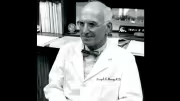
Operatic bass Ethan Herschenfeld ’90 never gave a thought to performing until he auditioned with his roommate, on a lark, for one of the Harvard-Radcliffe Gilbert and Sullivan Players’ operettas during freshman year. He became a familiar presence on Harvard stages, and decided to pursue acting, not medical school, but still did very little singing. Then, while enrolled in a speech class at the Actor’s Institute in London, he sang an operatic phrase as part of an exercise. The instructor encouraged him to take voice lessons.
Back home in New York, Herschenfeld began his vocal training, working for two years with tenor Franco Corelli and later with voice coach Armen Boyajian, while taking jobs in summer stock and earning a few roles on soap operas and cable TV shows. When an agent contacted him about flying to Sweden to replace a singer in a touring production of The Magic Flute, his solo career began. “I knew the role [Sarastro], but I had to learn a huge German monologue on the flight,” he says, “and I found out when I got to my hotel that I had to perform that same night with only a half-hour rehearsal. I was tempted to take a cab back to the airport, but after a bumpy first show, I got on track and by the end of the 12-day tour, I was hooked. I realized that this was something I could do.”
After more years of studying, auditioning, and singing in smaller productions, Herschenfeld won several competitions and began earning roles with major companies. A string of debuts in Italy included the role of Sarastro in The Magic Flute at Teatro La Fenice. “I’d been to Venice for some coaching 10 years earlier, right after the Fenice burned down,” he says. “It felt like a real arrival to be back there to sing a great role in the renovated opera house.”
Herschenfeld has sung in productions ranging from the traditional to the experimental, and witnessed staging concepts of every stripe. “I assume the audience is there, like they’ve been for centuries, to hear great singing and get wrapped up in a story,” he says. “I’m not interested in using the opera for a political or artistic agenda. I’ve been in lots of those productions and they generally don’t serve the music or the story, and the audience gets shortchanged.” He remains focused on the drama. In Turin last April, at the climax of his aria as King Marke in Tristan and Isolde, he dropped to his knees and reached out to grab the tenor’s face. “It wasn’t clear if I was going to strangle him, pinch his cheek, or what,” he recalls. “It was a spontaneous move which ended up complementing the scene.”
Having now sung more than 40 roles at more than 60 theaters in the United States, Europe, and Asia, his operatic career is thriving. Reviewers have cited his imposing stature, impressive voice, and dramatic skills; his classmate Alex Ross of the New Yorker noted, for example, that he made the most of the smallish part of Bluebeard in a 2005 New York City Opera production of Ariane et Barbe-bleue, giving “a sharp portrait of a dark, wounded spirit.” Yet Herschenfeld is still drawn to pure acting. When he heard that his friends Glenn Kessler ’92 and Todd Kessler ’94 were ready to cast Damages, their 2007 show on the FX television network, he flew home from an audition trip to Switzerland to read for a part, and ended up playing a hit man in the first season. “I usually get cast as the bad guy,” he says. “I don’t take it personally and it’s more fun, anyway.”
He sang Fafner in Rheingold in Bari and the Speaker in The Magic Flute in Rome this spring and then Alonso in Der Sturm in Amsterdam. (Hyperion is releasing a CD recording of the latter.) After that? “I’ll keep performing, in opera and maybe more TV, and I’m also busy as an investor in real estate and several start-ups. In college I studied a wide range of subjects. Turns out that was a good predictor of my professional life!”