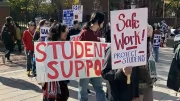
On the evening of April 30, 2024, the New York Police Department arrested 112 people in and around Columbia University’s Hamilton Hall after pro-Palestine protesters occupied the building. In Cambridge, McCormack professor of citizenship and self-government Archon Fung was “totally consumed” by the campus protests. “It felt like,” he said, “across the country, there was way more police response to this round of civil disobedience on campus” than other movements in his memory. The NYPD response led Fung to consider the appropriate use of force against protesters who engage in civil disobedience. How disruptive must an on-campus protest be to merit police intervention?
Fung is specifically interested in campus protest because universities believe in “reason and discussion as methods of resolving disagreement.” Corporations do not have an expressive mission and therefore have a lower tolerance for protest. (Google, for example, fired 28 employees who participated in a sit-in to protest the company’s contract with the Israeli government.)
In an essay published last week, “Campus Protests and Police Force: An Ethical Framework,” Fung crafted a four-step scale to grade a campus protest’s disruptiveness. He specifically investigated cases of civil disobedience, when protesters break laws “to get the good people of this country to take another look and re-consider the policies they thought to be just,” he wrote. The four-step scale, ordered from least severe to most, is as follows:
- At its least severe, civil disobedience breaks the rules but is not disruptive. For an encampment on campus, a university might have to mobilize additional security personnel.
- At the next level, he wrote, “civil disobedience is inconvenient, but tolerable.” An encampment might force minor relocation of university functions such as classes or exams.
- Gaining intensity, civil disobedience may disrupt important business to an intolerable degree. An encampment might be so loud that it disturbs teaching and learning, protesters may physically prevent students and faculty from attending class, and graduation might be disrupted.
- At its most extreme, civil disobedience threatens lives. This scenario could involve a melee between protesters and counter-protesters, or bystanders becoming trapped in an occupied building.
But even if everyone were to accept Fung’s scale, two major points of contention would remain. First, what level of protest should police break up? Some members of the Harvard community, Fung wrote, had called on interim president Alan Garber “to end the encampment because its presence violates Harvard rules and policies,” a description that could fit a mild, level one protest. Harvard Police Chief Victor Clay, on the other hand, told The Crimson that he would only arrest protesters in the case of “significant property damage or physical violence at any level,” describing a level four protest.
Such differences of interpretation within universities frequently have parallels in media accounts of civil disobedience. Hence, the second question: who determines the temperature of a protest? For the recent wave of student protests, Fung thinks there are “two non-intersecting news narratives going on.” One, primarily boosted by student journalists, describes the protests as peaceful and calm. The other, which he attributed to non-campus news organizations, depicts the protests as violent and antisemitic. Misrepresenting the true nature of a demonstration, Fung fears, could justify a heavy-handed response to a calm act of disobedience.
Fung believes universities should try their best to avoid police intervention in student protests. Difficult conversations about controversial issues, he said, “require great skill and great imagination… Wiping away the encampments requires no imagination at all.” Universities, he continued, “should be the innovators that help the rest of society figure out how to deal constructively with these very deep divisions, and I don’t think we’ve risen to that occasion yet.”
Aside from police intervention, Fung has observed two alternative responses to student encampments. First, schools can sit by and “see what happens,” he said, as Wesleyan University did. This approach entails leaving the protesters alone while ensuring, in the words of Wesleyan president Michael Roth, the “safety and capacity to pursue…education” of all students. Another tactic is to negotiate a settlement. This strategy, which Harvard used to achieve a peaceful end to the Yard encampment on Tuesday, has been criticized by some (including Senator John Fetterman and the Anti-Defamation League) for legitimizing rule-breaking students and their cause. But Fung argues that negotiation is the ideal outcome, writing, “the actual provisions—extending fora for student activists and university officials to consider and criticize the case for divestment—seem to me a sensible way to continue dialogue and debate.”
At Harvard, where the protesters and their tents have left the Yard, difficult conversations will continue.