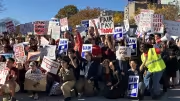
Harvard academic workers went on strike Tuesday, heaping new pressure on the University, which was already feeling the strain after graduate students walked off the job in late October. Some 6,500 teaching and research employees have now joined the picket line, emptying laboratories and classrooms in what has become the largest strike in Harvard history.
During a joint rally on Tuesday, hundreds of workers from both unions marched in front of Zimmer Hall and into Harvard Yard, chanting, “Harvard messed up, now we’re two!”
The walkout by academic workers is the most recent chapter in what has become a tumultuous semester of labor disruptions. On October 27, the Harvard Graduate Students Union-United Auto Workers (HGSU-UAW) struck for the second time in six months after contract negotiations fell apart.
Since then, picketers have disrupted at least one midterm exam and multiple campus events, including a lecture by author John Green, which was moved online after union leaders asked him not to cross the picket line, and a conversation between comedian Stephen Colbert and cellist Yo-Yo Ma ’76, which was canceled after a fire alarm went off in Sanders Theatre while union members protested outside. This week, Harvard Law School announced it would postpone the remaining rounds of its Ames Moot Court Competition because of the HGSU-UAW strike.
On November 5, University officials halted a bargaining session with HGSU-UAW leaders. In a letter to faculty members the next day, Deputy Provost Jessica Soban and Paul Curran, Harvard’s managing director of labor and employee relations, wrote that members of the University’s bargaining team had been “the target of inappropriate, disrespectful remarks by the UAW representative at the table near the scheduled end of the bargaining session. These remarks and this conduct were not only inconsiderate, but unproductive. With only a few minutes remaining in the scheduled session, the negotiations ended for the day.”
HGSU-UAW president Denish Jaswal characterized the incident differently. “The University came with zero proposals,” she wrote in a text, “and reiterated the proposal that they presented two weeks ago, which was unacceptable to our membership. They actually ended the session early, because they thought it was absurd that we would suggest student workers would self-harm as a result of not having any real pathways to recourse when experiencing harassment and discrimination.”
Grievance complaints have emerged as a major sticking point between the union and the University. HGSU-UAW leaders are demanding an independent arbitration process to address harassment, bullying, and discrimination, which they say affects one in five members. Harvard’s internal process, they contend, is confusing and inadequate. The University has resisted this demand, arguing that HGSU-UAW’s proposal would conflict with Title IX regulations and with a University policy mandating that all community members be subject to the same grievance procedures. The University revised those procedures in 2023, with input from students, faculty, and staff.
On November 10, Curran—in a sign of just how stuck the negotiations are—sent a message to HGSU-UAW’s leadership team, asking them to consider engaging a mediator to help reach an agreement. “While the discussion about mediation in our bargaining session on Thursday, November 5, did not result in the two parties moving forward on this option, we do think it merits further consideration,” he wrote. Harvard and HGSU-UAW worked with mediators during negotiations for two previous contracts.
Meanwhile, the Harvard Academic Workers-United Auto Workers (HAW-UAW) union is still negotiating for its first contract, more than two years after it was formed in April 2024. Its membership includes about 2,500 non-tenure-track faculty and researchers, including lecturers, preceptors, instructors, postdoctoral fellows, teaching assistants, research associates, and adjunct faculty members. Some of the union’s central demands echo those of HGSU-UAW, including higher wages, a stronger grievance process, and better protections for non-citizen workers, who have come under increased threat during the Trump administration.
In an email to the University community Tuesday, Harvard provost John Manning and executive vice president Meredith Weenick acknowledged how long the bargaining process has taken but disagreed with the union’s decision to stop work. “Although we recognize HAW-UAW’s right to undertake the strike they began today,” they wrote, “the University believes that with the substantial progress already made to date, outstanding issues can be resolved at the bargaining table.”
On most of the union’s core issues, the two sides are close to an agreement, said J. Gregory Given, an Expository Writing preceptor and a member of the union’s bargaining committee. Time caps, a longstanding University practice requiring non-tenure-track faculty members to leave their positions after a certain number of years, “aren’t going to exist anymore,” Given said. Instead, they’ll be replaced by a “lecturer ladder” allowing full-time lecturers to keep their jobs, so long as a curricular need and budgetary resources remain. Preceptors will also be reclassified as lecturers.
Harvard and HAW-UAW leaders have also tentatively agreed, Given said, on layoff and severance provisions, workload protections, and just-cause requirements for dismissal. “Under the status quo,” he said, “workers like me can be dismissed at any time with no notice.”
Several disputes remain, however, including over wages. The University’s most recent offer, detailed in the email from Manning and Weenick, would raise union members’ pay 3.5 percent upon ratification of the contract, and then 3.25 percent each year for the next three years. But HAW-UAW contends that its members would have received a 3 percent cost-of-living raise last July if they were not unionized; that raise was withheld, Given said, and the University’s compensation offer does not include back pay. The union has filed an unfair labor practice charge.
The two sides are also at odds over how many workers are eligible for union membership. Harvard wants to exclude 300 to 400 positions, including researchers paid through stipends rather than a regular salary or hourly wage—a category that includes fellows, junior fellows, and trainees. The University argues that these workers are not employees of Harvard; Given called that position “nonsensical.” Some stipends come from the University itself, he pointed out, through units such as the Mahindra Humanities Center or the Society of Fellows. Many other stipend recipients are postdoctoral fellows in Harvard laboratories who receive outside funding through grants or fellowships.
Often, Given said, these workers alternate between salaries and stipends, while their job responsibilities and supervisors remain the same. “In some cases, workers don’t even realize when they’re switching back and forth between these different types of pay,” he said. At other institutions, including Columbia University, the University of Pennsylvania, Cornell University, the University of California system, and the Icahn School of Medicine at Mt. Sinai, stipend recipients are included in academic unions.
One other point of contention is union security provisions, which would require workers covered by the contract to pay dues or fees to the union, whether or not they join it. This is a standard clause in most private-sector contracts, including the ones Harvard has with its dining workers, custodians, and clerical and technical workers. Only HAW-UAW and HGSU-UAW do not have this provision as part of their contracts.
In their letter, Manning and Weenick wrote, “The University believes that academic workers should be able to decide for themselves to opt to join a union or pay union dues when they accept union-eligible teaching or research positions.” Given took issue with that explanation, arguing that “there’s an implicit elitism in the idea that academic employees are somehow different than other workers…The way they’re trying to draw that line seems just really tendentious.” (Teaching and research assistants at private universities—unlike their peers at public universities—were legally prohibited from forming unions until 2016, when a National Labor Relations Board ruling declared they had the right to organize.) HGSU-UAW leaders are also negotiating for union security.
At Wednesday’s rally, members of the two unions marched together, holding signs with slogans like, “Prestige Doesn’t Pay the Rent,” and “Safe Work, Fair Pay.” One demonstrator wore a denim jacket with the words “United We Bargain, Divided We Beg” across the back, encircling an image of a raised fist.
Several speakers accused the University of union-busting tactics, pointing to its efforts to exclude certain workers from the unions and its resistance to union security provisions. “If Harvard is successful in these carve-outs, this is something every university with unionized academic workers will be doing in the future,” said Gage Martin, a Pierce Fellow in the mathematics department.
There were numerous references Harvard’s endowment, which is now valued at $68 billion, according to a financial report released last October, although 80 percent of that money is restricted, meaning it can only be spent as donors and sponsors direct, and only five percent is fully unrestricted to support programs across the University. Union members also pointed to the $18.5 million the University expects to save annually from the recent restructuring and layoffs in the Faculty of Arts and Sciences.
“The [Harvard] Corporation is getting richer, while we are getting poorer,” said Julien Foriel, a research scientist and HAW-UAW bargaining committee member who has worked at the University for eight years.
“Our demands are not exceptional,” Foriel told the crowd. “Plenty of unions of postdocs, researchers, non-tenure-track faculty, and grad students have won what we’re trying to win.” (HAW-UAW leaders have pointed to unions at peer universities like Columbia, New York University, and Cornell as examples.) He added, “We are bargaining in an existential way for our livelihood and careers.”
HAW-UAW’s next bargaining session is scheduled for November 17, although Given said he and other union leaders have asked the University to meet sooner. “We’re going to send them some counter proposals via email this week,” he said. “We’ve let them know we’re ready to meet anytime—our days are free right now.”