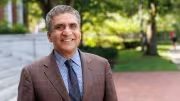
At the last regular faculty meeting of the 2024-2025 academic year on Tuesday, Faculty of Arts and Sciences Dean Hopi Hoekstra articulated what most in attendance had already surmised: the federal government’s suspension of research funding will have lasting effects that will require “difficult decisions.”
Any resolution of the standoff, in which Harvard has rejected the government’s attempts to control who is hired and what is taught in Harvard classrooms, will likely involve a protracted legal process, Hoekstra told the capacity crowd of several hundred professors. And even if Harvard were to prevail in court, that would not guarantee the resumption of $3.5 billion in research funding frozen by the Trump Administration. She also noted that proposals to tax the University endowment represent a further threat to the revenue on which ongoing teaching and research depend.
“To preserve our mission, we must act now,” Hoekstra continued, even with imperfect and incomplete information—and she outlined three steps that FAS would take to help chart a path forward. She did so, she said, out of a “profound sense of responsibility” to protect the livelihoods and ability of the faculty to do the research and teaching that they came to Harvard to pursue.
First, Hoekstra said, she had formed a Research Continuity Committee to develop principles and a process for allocating research continuity funding, by reviewing funding proposals and making recommendations in order to help support scientists conducting sponsored research. The committee, which will be chaired by Distinguished Service professor and McPike professor of stem cell and regenerative biology Steven Hyman—a former University provost—will consult with researchers nominated by department chairs and then make recommendations directly to Hoekstra.
She noted that the impacts on FAS and the School of Engineering and Applied Sciences (with which planning is being aligned) are distinct from those at Harvard Medical School and the T.H. Chan School of Public Health, both schools far more reliant on federal funding to sustain their daily operations.
Hoekstra said the FAS would also undertake a formal administrative review to analyze staffing across FAS and identify opportunities to “increase collaboration, integration, and productivity….” Recommendations of the Task Force on Workforce Planning may include proposals for staff reorganizations and reductions.
A third step, she said, would reactivate the Faculty Resources Committee, which will advise her on strategies to preserve and strengthen FAS’s core research and teaching mission, and seek faculty input. “We need your collective wisdom to chart a path forward,” she said, “to ensure that our mission emerges strong, and that Harvard’s call for truth rings out clearly for the next 400 years.”
Loud applause greeted Hoekstra’s comments in the Faculty Room of University Hall, where late arrivals, finding no empty seats, had elected to sit on the floor.
Following Hoekstra’s remarks, there was no new business introduced and no questions from the faculty. They were likely anticipating a private, in camera portion of the meeting during which provost John Manning was scheduled to answer questions, presumably about the impasse with the Trump Administration and the University’s evolving response.