Harvard’s annual financial report for the fiscal year that ended on June 30, 2026, published today, shows more favorable results than might have been expected given dramatic reductions in federal research support, the enormous legal costs of defending the University against Trump administration actions—$157 million this year—and the expansion of financial aid awards to undergraduates. The report also reveals extraordinary growth in the endowment, now valued at $68 billion, and strong levels of philanthropic support. On paper, the University even managed a small surplus of $100 million—the equivalent, in an operating budget of $6.7 billion, of five days’ expenses.
But the good news was tempered by the steps required to achieve a balanced budget, including staffing reductions that played out across the University. Administrators announced that the endowment distribution for fiscal year 2027 would be flat—zero increase from the prior year—in order to pay an estimated $300 million in taxes in the fiscal year that began on July 1, when a federal tax first enacted in 2017 was expanded so that the tax on select universities’ endowment investment gains increased nearly sixfold.
Among the noteworthy aspects of the report:
• The endowment’s value rose to $68 billion as of June 30, 2026—an increase of $11.1 billion (19.5 percent) from $56.9 billion a year earlier.
• Harvard Management Company (HMC) recorded a 27.1 percent investment return on endowment assets during fiscal year 2026, up from 11.9 percent in the prior year. That was the second highest return recorded during the past decade, exceeded only by a remarkable 33.6 percent return in fiscal year 2021, during the pandemic-era market rebound.
• The University ended the fiscal year with a $100 million operating surplus. But that positive outcome was the result of balancing an $80 million deficit in the unrestricted funds used to support general operations against a $180 million surplus in restricted funds that can only be spent as donors and sponsors direct.
Harvard’s endowment is composed of roughly 15,000 separate funds, of which 80 percent are restricted. Most of the remaining funds are allocated to specific schools or units. Less than 5 percent is fully unrestricted to support programs across the University.
• Legal expenses, which amounted to $126 million last fiscal year, were sharply higher this year, even as the cost of other services, such as contracts, consulting, and subcontracted work associated with sponsored research declined. According to a Harvard spokesperson, ongoing and one-time legal fees in fiscal year 2026 accounted for approximately $210 million of total services of more than $1 billion purchased by the University. The legal expenses included the litigation of appeals, by the Trump administration, of initial federal court rulings favorable to Harvard. It also included Harvard Medical School’s $53 million settlement with the families of donors in a body parts theft case.
• Gifts for current use set a new record. Of more than $1.5 billion in gifts received during fiscal year 2026, $684 million was for current use, an increase of 9 percent over the previous year, and the highest in the University’s history. Including distributions from the endowment—the result of past philanthropy—giving provided 48 percent of Harvard’s fiscal year 2026 revenue: 39 percent from the endowment distribution and 10 percent from current use gifts.
• Harvard increased its commitment to financial aid in fiscal year 2026, as Harvard provided more than $775 million to its students. Of that total, $510 million was expended to support graduate and professional students, while $265 million in need-based scholarships supported 55 percent of College undergraduates under an expanded financial aid program that debuted in 2026. Students from families earning less than $200,000 attend tuition-free, while those from families earning less than $100,000 attend free altogether.
• The budget was balanced by cutting expenses, not by rising revenues, which were largely unchanged. Salaries and wages, the University’s largest expense, declined by $104 million (3.8 percent), according to the report, “as a hiring freeze, attrition, and restructurings reduced Harvard’s workforce.”
“The Age Unfolding Now”
President Alan Garber, in his message accompanying the report, remained focused on the opportunities of the present age—and the future. “Each passing month brings new revelations that the pace and scale of discovery are accelerating rapidly. To be true to its past and its mission,” he wrote, “Harvard must be at the forefront of the age unfolding now.”
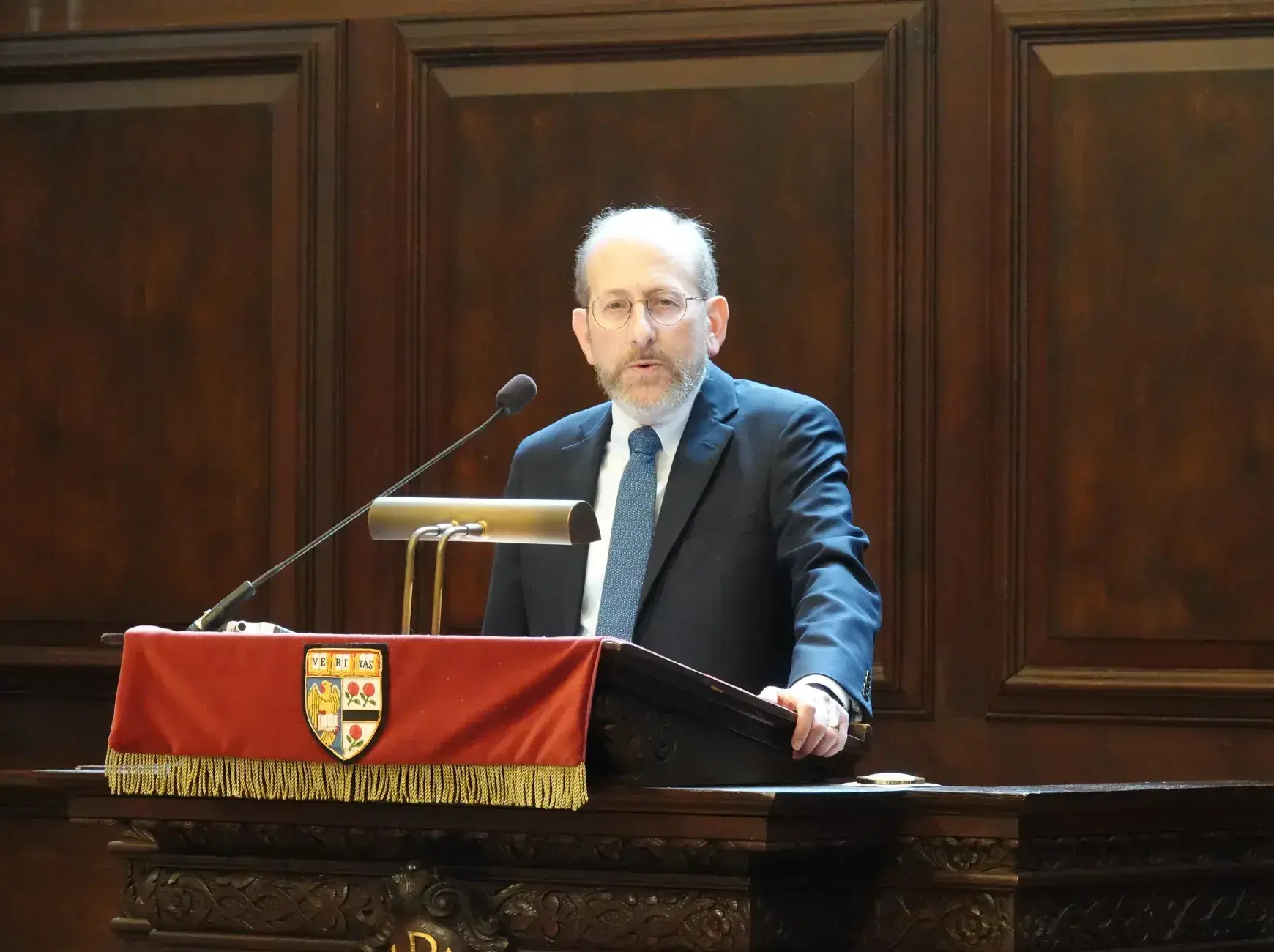
Harvard is confronting “complex and consequential challenges,” he said, adding that “careful stewardship of financial, intellectual, and human resources…have helped to ensure that Harvard will not only persevere but thrive.”
He also celebrated the continued recognition of Harvard’s people, who have received “the highest accolades in academia,” and the support of alumni and friends who “sustain our activities through generous philanthropy.” “We are deeply grateful,” he added, “for these votes of confidence in the role that our community will continue to play in improving the wellbeing of countless people and in making the world a better place.”
The financial management leadership—Ritu Kalra, the vice president for finance and chief financial officer (and a member of this magazine’s board of directors), and Timothy R. Barakett, the University’s treasurer—used their letter to expand on the rising importance of philanthropy to the University’s resilience in the face of financial shocks. The largest of those shocks, they wrote, was “the abrupt termination of federal research grants in the spring of 2025 [which] unsettled a research enterprise built over decades—along with the discoveries, treatments, and trained scientists it continues to produce.”
“As the year progressed,” they wrote, “responding to immediate disruption gave way to the harder work of reshaping operations for a changed environment.” This included staffing reductions; they made a point of recognizing the sacrifices made by those colleagues directly affected.
The largest drop in income affected federally sponsored research, where reported revenue declined 20 percent. But that figure understates the true impact, because it includes $116 million in research funding that was terminated in 2025, but then restored in fiscal year 2026 after favorable court rulings.
If those funds, logged as non-operating revenue, were excluded from the 2026 accounting of federally sponsored research revenue, the drop would be close to one-third. That outcome is consequential, as the University sustained more than $1.2 billion in research activities: $500 million from federal sponsors, $300 million from non-federal sponsors, and $400 million from the University itself.
Kalra and Barakett also used their letter to explain the impact that an increased federal excise tax on realized net investment income will have next year. In fiscal year 2027, that tax will rise nearly sixfold, from 1.4 percent to 8 percent, imposing an estimated cost of approximately $300 million a year. While the precise amount will fluctuate from year to year depending on the endowment’s investment performance, the University’s balance sheet now reflects that future tax liability—$1.9 billion, “most of it deferred—an accounting estimate of future taxes on unrealized gains. As those gains are realized,” the pair wrote, “the resulting taxes will reduce resources otherwise available to support faculty, students, and academic programs.”
The difficult financial circumstances and decisions made during the past year were framed by the University’s financial leaders in terms of Harvard’s long-term objectives. “Forging ahead through the uncertainty,” Kalra and Barakett wrote, “will require financial strength and institutional judgment: knowing what to change and what to preserve, when to recalibrate and when to invest.” Notably, they continued, “The work ahead cannot be defined by restraint alone. The University’s enduring commitment is to direct its financial capacity to exceptional teaching, consequential research, and the people and ideas that make both possible.”
Not mentioned in their letter are other factors affecting revenue and expenses. A softening in tuition income derived from executive education programs is one. As recently as fiscal year 2024, executive and continuing education was the standout in tuition revenue growth, rising 8 percent over fiscal year 2023. That expansion continued into fiscal year 2025. But a decline in international enrollments and federally funded professional participants in these programs in fiscal year 2026 led to growth of less than one percent over the prior year. One the expense side, capital expenditures—the costs of maintaining Harvard’s physical plant and equipment—are approaching $1 billion annually.
Harvard’s balance sheet remains strong: liquidity is good, debt is virtually unchanged, and the University continues to hold a AAA credit rating. And the bright spot in fiscal year 2026 was the endowment’s performance. In their letter, Kalra and Barakett explained why extraordinary returns on investments and painful cuts can co-occur: “The University deliberately smooths distributions so that operating support does not rise and fall with the markets. Strong investment returns therefore support Harvard’s work gradually, through future distributions; they neither create immediate flexible resources nor, on their own, resolve structural gaps between recurring revenues and expenses. That is why exceptional investment returns and difficult structural changes can, and did, occur in the same year.”
Endowment Results
Harvard Management Company reported a 27.1 percent return (net of investment expenses) on endowment assets during fiscal year 2026, more than double the 11.9 percent realized in the prior year. As HMC chief executive N.P. Narvekar emphasized in his letter, which is included in the annual financial report, the importance of the endowment is substantial: “In [fiscal year 2026], distributions from the endowment totaled $2.6 billion—nearly 40 percent of the University’s annual operating revenue.” That performance, he wrote, “far surpassed Harvard’s long-term return objective of 8 percent,” which is meant to balance a 5 percent annual distribution rate and annual inflation of 3 percent or so, thus maintaining spending power for the long term.
“Over the course of the current management team’s nine-year tenure,” he continued, “the portfolio has generated an annualized return of 11.4 percent. That longer-term record,” he added, “is the more important measure of the endowment’s ability to provide stability during challenging periods while preserving purchasing power for generations of students and scholars to come.”
In comparison to peer institutions, Harvard’s performance this year was excellent, virtually identical to the 27 percent return realized by the University of Virginia Investment Management Company in fiscal year 2026—and dramatically better than the MIT Management Company’s return of 10.3 percent for the year (whose 10-year annualized performance is nevertheless 11.7 percent). The average performance of college and university endowments for the year, based on preliminary estimates by Cambridge Associates, was 15.5 percent. Among peers who have reported results so far this year, only Stanford, which announced a 31.7 percent investment return, outperformed Harvard Management Company, which invests the University’s endowment.
This past year’s performance, Narvekar wrote, “was driven primarily by three asset classes: venture capital, public equities, and hedge funds. The [fiscal year 2026] returns were also shaped by the portfolio’s composition, as we deliberately grew private equity to be the largest part of our portfolio.” While proud of the outperformance above relevant market benchmarks, Narvekar cautioned that “outsized returns can sometimes portend subdued, or even negative, returns in the near term.”
Narvekar, who told the HMC board that he plans to retire around the end of 2027, also noted the value of local knowledge in investing Harvard’s portfolio in the global context. HMC maintains two satellite offices, one in Singapore that opened four years ago, and a second, opened one year ago, in San Francisco. “Our purpose,” he wrote of this latest expansion, “was to develop deeper connectivity within an ecosystem at the forefront of a technology that is reshaping the economy and every major market in the world.”
Narvekar took the opportunity to memorialize HMC’s first president, Walter Cabot ’55, M.B.A. ’59, who died in June. He “not only laid the foundation for HMC’s future success but helped revolutionize endowment management itself,” Narvekar said, adding, “All of us at HMC are grateful for his exceptional stewardship of Harvard’s most critical financial resource, and we aim to serve the University with the same conviction, purpose, and humility.”