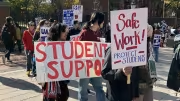
For decades, Harvard Extension School students have chafed at the wording on their diplomas, which grant them degrees in “extension studies”—a phrase many view as outdated, ambiguous, and stigmatizing. There’s even a student-led group, the Extension Studies Removal Initiative, which organized in 2020 to press administrators for a new name.
Soon they may finally get their wish: at a Faculty of Arts and Sciences (FAS) meeting on November 3, Division of Continuing Education (DCE) Dean Nancy Coleman announced a proposal for a broad set of reforms that would not only rename the Extension School’s master’s degrees but restructure the whole division.
Under the proposed plan, the DCE—which is part of the FAS and houses the Extension School, the Harvard Summer School, Harvard Professional and Executive Development, and the Harvard Institute for Learning in Retirement—would be rebranded as the Harvard School of Continuing and Professional Studies. Existing names for the Extension School and the Summer School would likely be retired or revised, although their academic structures and curricula would remain the same.
At the meeting, Coleman explained the rationale: “A name that accurately communicates who you are can have a meaningful impact on your ability to fulfill your mission,” she said, “particularly for the students we all serve.”
And the degree title? Instead of a Master of Liberal Arts in Extension Studies, graduates would receive either a Master of Liberal Studies (for liberal arts programs) or a Master of Professional Studies (for professional and applied programs).
Several faculty members stood up to speak in support of the changes. “I think this is a wonderful proposal, and it’s long overdue,” said Martin Puchner, the Wien professor of drama and of English and comparative literature, who has taught in the Extension School for 30 years, beginning when he was a graduate student at Harvard. Extension School students, he said, have been “among the best” he has worked with.
“That group has been treated very unfairly,” he added, “in the sense that no matter what classes they took, no matter what area of expertise they developed, no matter the area of their research, they would get a degree in extension studies.”
Peter Girguis, a professor of organismic and evolutionary biology who has taught at the Extension School for many years, also spoke in favor of the name changes. In an interview after the meeting, he said, “This is first and foremost about the students, and enabling them to have a degree that clearly articulates what they learned and where they learned it.”
One of Harvard’s 12 degree-granting schools, the Extension School allows anyone to take classes, but students who want to enroll in a degree program must first pass what the DCE calls an “earn-your-way-in” admissions process, scoring a B or higher in three required courses. “I deeply admire the rigor of the programs,” Girguis said. “So many DCE students come to the school at a time when they are hungry for growth, and DCE offers that in spades.”
The term “extension” dates to the nineteenth century, when universities began expanding their teaching beyond campus, offering college-level classes to working adults and members of the public. At Harvard, the Extension School grew out of the Lowell Institute, founded in the 1830s to give free public lecture courses in Boston. Its faculty included numerous Harvard professors, and in 1910, Harvard authorized the formation of a Department of University Extension, which later became the Harvard Extension School.
Today, though, the phrase “extension studies” confuses both potential students and employers. Graduates have long complained that it obscures the content of their academic work and trips them up on job applications and in conversations with colleagues. (At their rallies, members of the Extension Studies Removal Initiative often held up signs that read, “We Don’t Study Extensions.”) In her remarks at the meeting, Coleman sympathized with students’ frustrations. “We have to clearly communicate to employers what our students bring to the job, what they have learned,” she said.
Emphasizing that DCE remains “deeply committed” to expanding access to education, Coleman suggested that the name change might attract more students. That’s a not-insignificant factor, considering DCE’s financial contribution—it not only pays for itself through tuition revenue but generates a surplus within the FAS. “In better serving our students, by increasing enrollment and engagement,” Coleman said, “we can better serve all FAS students and our faculty by increasing resources available for this work.”
Girguis echoed that idea and said that higher enrollment in the DCE could be especially important “in this moment, when we are seeing a contraction of support for students in the Faculty of Arts and Sciences—fewer federal grants, fewer graduate students…There might be an opportunity here to further deepen the relationship between DCE and FAS departments.”
Coleman and other DCE leaders developed the proposed changes after conducting a naming study that examined peer universities’ practices and surveying students and other stakeholders. But this is not the first time the division has considered rebranding—previous efforts stretch back decades. Michael Shinagel, who served as DCE dean from 1975 to 2013, advocated without success for renaming the Extension School degrees during his tenure. This month he applauded the new proposal. “The new names of the school and the degrees are a much more accurate reflection of what we do at Harvard and how our educational programs have evolved over the years,” he said in an email message. “Continuing education has grown at Harvard and nationally and internationally. These changes all reflect a new reality.”
The proposal does not include a change to the division’s undergraduate degree title, the Bachelor of Liberal Arts in Extension Studies. Instead, Coleman said, the DCE is planning to review the program, examining enrollment trends, program distribution, and long-term priorities. (The Extension School attracts many more graduate students than undergraduates. In 2026, it awarded 1,290 master’s degrees and just 136 bachelor’s degrees.)
The FAS is likely to vote on the proposed changes at its December meeting. If the plan wins approval from the FAS and the University’s governing boards, Coleman said, it would take effect on April 6, 2027.