“Birds of the World” at Harvard’s Museum of Natural History

A new exhibition of birds of the world

Hornbills, including the Malaysian state bird, <i>Buceros rhinoceros</i> (right)

Hornbills, including the Malaysian state bird, Buceros rhinoceros (right) | Photograph by Jim Harrison

A roseate spoonbill and two ibises

A roseate spoonbill and two ibises | Photograph by Jim Harrison

The massive Australian southern cassowary (in back) and emu dwarf a brown kiwi from New Zealand.

The massive Australian southern cassowary (in back) and emu dwarf a brown kiwi from New Zealand. | Photograph by Jim Harrison

A fiery-breasted bush-shrike

A fiery-breasted bush-shrike | Photograph by Jim Harrison

Hooded mergansers sometimes appear on the Charles River.

Hooded mergansers sometimes appear on the Charles River. | Photograph by Jim Harrison

The Himalayan monal is found in Afghanistan, Bhutan, India, Tibet and Myanmar.

The Himalayan monal is found in Afghanistan, Bhutan, India, Tibet and Myanmar. | Photograph by Jim Harrison

A Malayan peacock-pheasant, found in southern Myanmar, southern Thailand, and Malaysia

A Malayan peacock-pheasant, found in southern Myanmar, southern Thailand, and Malaysia | Photograph by Jim Harrison

The red-billed streamertail, a hummingbird, hails from Jamaica

The red-billed streamertail, a hummingbird, hails from Jamaica | Photograph by Jim Harrison

The copper pheasant (right) is found in Japan; the Reeves's pheasant, originally native to north and central China, has been introduced to Europe.

The copper pheasant (right) is found in Japan; the Reeves's pheasant, originally native to north and central China, has been introduced to Europe. | Photograph by Jim Harrison

A parliament of owls

A parliament of owls | Photograph by Jim Harrison

A selection of tanagers

A selection of tanagers | Photograph by Jim Harrison

The great mammal hall has been emblematic of the Harvard Museum of Natural History for decades. Traditionalists will be glad to know that the gorilla tirelessly pounding on his chest, the placid okapi, and the room-long whale skeleton are still in place, and birds still fill cases on the balconies that run all around the hall. But the birds are no longer solely the “Birds of North America,” as has been the case for ages. Like the University that houses them, they have become more cosmopolitan and are now “Birds of the World.”

“I’m staggered by their diversity,” said Maude Baldwin, a doctoral student and teaching fellow in organismic and evolutionary biology, whose particular interest is hummingbirds. She and Jennifer Berglund, an exhibit developer and writer, spent many months preparing this permanent exhibition, which opened last fall. First, they refurbished the elderly display cabinets themselves. To populate the cases, they drew on the vast collection of the Museum of Comparative Zoology—350,000 bird specimens—vacuuming the dust of years from feathers, brightening eyes to restore their shine, and revealing the color and iridescence of plumage through proper lighting. Then they made everything fit—and make sense.

Shown first are hornbills, mostly tropical birds who bear a large bill topped by a unique hollow structure, called a casque. The hornbill at right in the group is Buceros rhinoceros, the Malaysian state bird; the others are from Africa.

Next are a roseate spoonbill and two ibises. One might encounter the spatula-equipped wader in the southeastern United States or South America east of the Andes. The scarlet ibis is from northern South America. A white ibis is in the corner. A copper ibis, of course, may ordinarily be found on the dome of the Harvard Lampoon building.

The solitary bird is a fiery-breasted bush-shrike, from equatorial Africa. It is colorful even in its present circumstances.

The flightless southern cassowary can grow 75 inches tall. In front are another Australian resident, an emu, and a brown kiwi, a New Zealander. (The birds that follow are identified in captions.)

Baldwin and Berglund arranged their avian citizens to reflect not just biogeography but also current scientific understanding of the relationships among birds—their phylogeny. The result, Baldwin believes, is “both beautiful and correct.”

The Birds of the World exhibit is made possible by a gift in memory of Melvin R. Seiden ’52, LL.B. ’55. 

Read more articles by Christopher Reed

You might also like

Padimut at Harvard

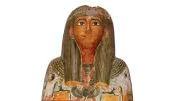
A rare Egyptian mummy case is on display at the Harvard Museum of the Ancient Near East.

There’s a New Sargent Painting in Town

Harvard Art Museums restores a rare glimpse of an American master.

Don’t Call Stephanie Pierce A Paleontologist

From competing in youth gymnastics to studying tetrapods, the Harvard curator has always chased her curiosity.

Most popular

Harvard Stabilizes Finances With Strong Endowment Returns, Philanthropy

Small operating surplus is dwarfed by reduced federal research support and endowment tax liabilities.

How Philosophy at Harvard Saved Itself

As humanities shrink across higher education, one department is flourishing. Is its success a fluke, or a roadmap?

Treat AI Like a New Species, Harvard Scientist Says

Joshua Joseph discusses how society can manage and coexist alongside self-governing AI agents.

Explore More From Current Issue

Ancient Egyptian painted sarcophagus with detailed hieroglyphs and a woman's face.

A rare Egyptian mummy case is on display at the Harvard Museum of the Ancient Near East.

A girl in blue boots stands on a cliff, holding a leash attached to a glowing, digital dog.

Establishing legal responsibility for autonomous agents

Delicate green cocoa pods and small white flowers on a tree branch, surrounded by soft greenery.

Harvard researchers investigate climate’s impact on cocoa crops, innovations in nasal vaccines, and links between pain and skull marrow.