Behind the Scenes: Two Lives Against a Terminal Disease
Senior editor Lydialyle Gibson reflects on Sonia Vallabh and Eric Minikel’s personal race to find a treatment for prion disease.
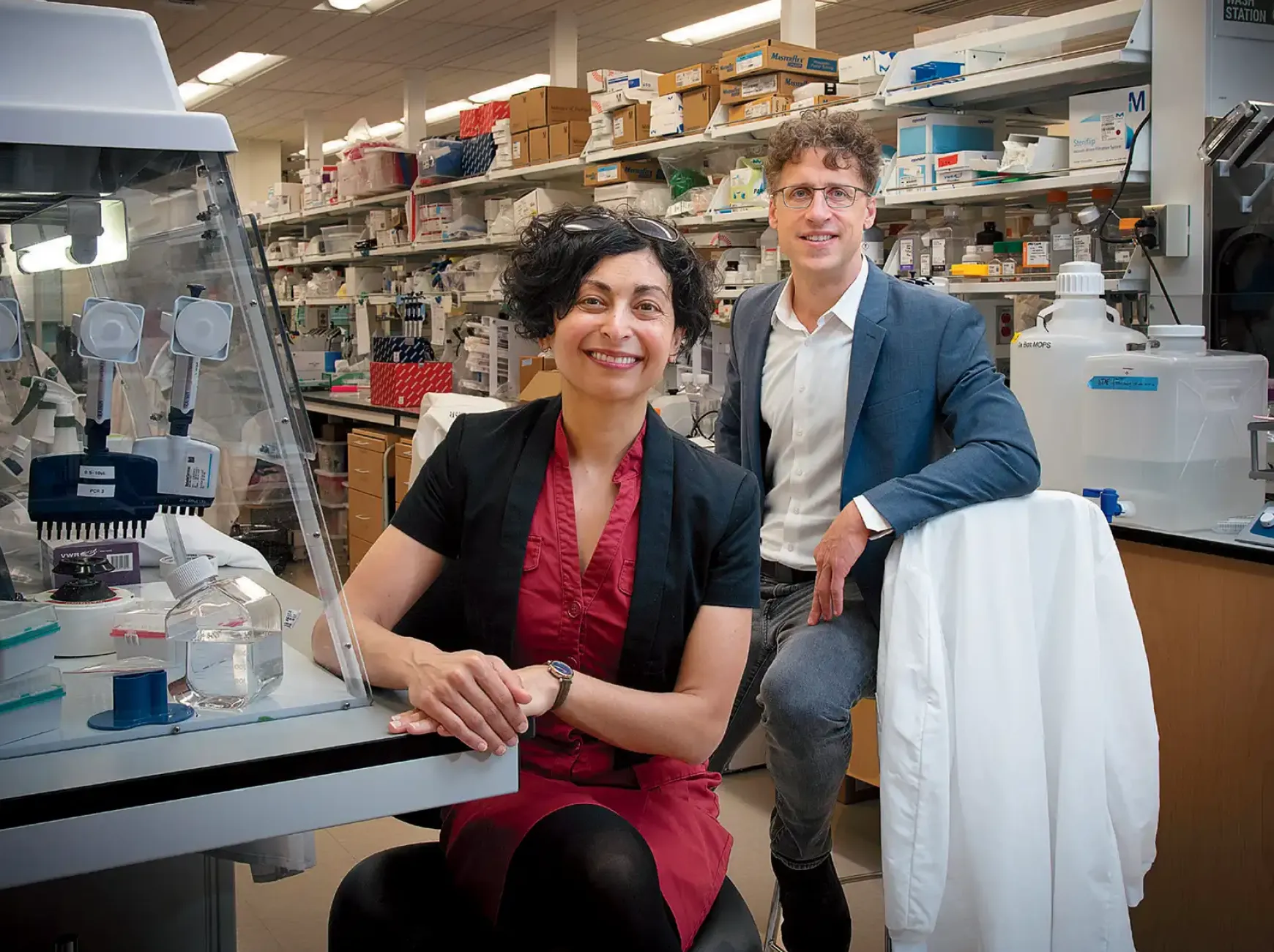
I’ve been thinking about Sonia Vallabh, J.D. ’11, Ph.D. ’19, and Eric Minikel, Ph.D. ’19, for years. I imagine many people have.
I first read about their research in 2019, when Wired magazine published a long feature about the couple’s desperate race to find a cure for prion disease, a fatal, fast-moving neurodegenerative illness that had struck Vallabh’s mother in her early 50s—killing her within a year—and that Vallabh discovered she, too, would someday develop, due to an inherited genetic mutation.
The story was stunning. It described how Vallabh and Minikel, neither of whom had studied science in college (she was a consultant with a law degree; he was a transportation analyst), returned to the classroom and began retraining as scientists almost as soon as they received her test results. Eventually, they went back to school full time and in 2019 received their doctorates from Harvard’s biological and biomedical sciences program. By then, they’d already spent several years amassing research on prion disease, working toward their goal of finding a cure in time to save Vallabh’s life. They’d launched the Prion Registry, an online listing to recruit research participants, and the Prion Alliance, a nonprofit to solicit research funding.
They had also become parents. In 2017, Vallabh and Minikel had a daughter, and in 2020, a son. The couple used genetic screening and in vitro fertilization to make sure neither child was born with a mutation for prion disease. In announcing their son’s birth on his blog, Minikel wrote, “Our lifelong quest to cure prion disease marches on. Our decision to grow our family is one more manifestation of our optimism that we have many years ahead to watch these wonderful kids grow up.” He and Vallabh, he wrote, were “blessed beyond measure.”
I think that quote sums up one reason the couple’s story is so compelling. After receiving the worst possible news—a test result that essentially amounted to a death sentence—Vallabh and Minikel reacted with the opposite of hopelessness. They were newly married when Vallabh’s mother fell ill in 2010, a young couple embarking on their lives together. It’s profoundly moving to think of the courage and strength it took for them to choose the path they did.
That choice is all the more inspiring when you learn about the brutality of the illness. Prion disease is rare, but harrowing—symptoms include severe and rapidly accelerating dementia, loss of motor control, and an increasing inability to sleep. There are several subtypes of the illness, the most common of which in humans is Creutzfeldt-Jakob disease. Vallabh’s mother died from a subtype called fatal familial insomnia. Her decline was so swift and bewildering that it was only after her death that doctors were able to identify a diagnosis.
In the years since I first read about their story, I’ve thought often of Vallabh and Minikel. I’ve wondered about the progress of their research and tried to imagine what it must feel like to be engaged in such a furious race against time. The clock is ticking for Vallabh, but they do not know exactly when she might develop the disease.
And so it was rewarding to be able to talk with Vallabh and Minikel for a story in the September-October issue of Harvard Magazine about some of the recent advances they have made. Earlier this year, they began enrolling patients in a clinical trial for a new kind of drug aimed at silencing the gene that causes the disease. Meanwhile, a different clinical trial launched in 2023 to test a separate drug is continuing, and the couple have also been collaborating with other researchers on two other potential therapies: a DNA base-editing tool and an epigenetic therapy aimed at changing genetic expression, which could switch off the disease-causing gene entirely. As Vallabh says in the article, by pursuing multiple possibilities at once, they are “building a runway” for a potential breakthrough.
I will keep following their story, and I hope that readers find their work as powerful and inspiring as I have. I’m grateful to donors for making it possible for us to tell stories like this, about a drama unfolding on the frontier of science, in which the stakes for the researchers couldn’t be higher.
Explore “Harvard Couple Aim to Cure Prion Diseases”