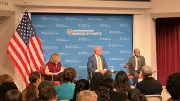
University President Drew Faust testified before a Congressional committee this morning, urging lawmakers not to cut—or even level-fund—the federal budget for scientific research grants at this critical juncture.
The leveling off of grant funding through the National Institutes of Health has caused a slowdown in the sciences similar to the downturn gripping the U.S. economy, Faust said. Coming on the heels of an earlier expansion—the NIH budget doubled between 1998 and 2003—the flat funding has left "brilliant young researchers...stuck behind their mentors in a funding queue that is stalling promising careers in academic research and pushing many with substantial promise to seek alternative paths," she told the Senate Committee on Health, Education, Labor, and Pensions this morning, according to her remarks as prepared for delivery.
"NIH will spend $30 billion this year in labs across this country that will continue to produce startling new results – for which we thank you sincerely," Faust said. "But we cannot afford to simply tread water."
Questions of diagnosing, treating, and even curing cancer are becoming more pressing as baby boomers reach a more cancer-prone period of life, but Faust said that investigators, instead of stepping up the pace, "are downsizing labs, slowing research, and producing more conservative, less ambitious proposals that are more likely to secure funding."
Faust provided her listeners with a copy of a new report, “A Broken Pipeline? Flat Funding of the NIH Puts a Generation of Science at Risk,” that was also released today. The report is a collaborative effort from Harvard, Brown, Vanderbilt, and UCLA; Partners Healthcare, the parent organization of two of Harvard Medical School's largest affiliated hospitals; the Duke University School of Medicine; and the Ohio State University Medical Center.
To assess the current climate for research, Faust said, "We interviewed 12 brilliant junior faculty at seven institutions across the country, who work in several different fields. ...These researchers were trained at some of the best institutions in the world, mentored by leaders in their scientific fields, have been recognized for their early work, and hold tremendous promise for the future of science. If these scholars are struggling, it is clear that as a nation we most certainly have a problem."
The report is available here. Faust's full testimony, as prepared, is available here.