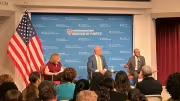
Harvard Names Open Access Architect Director of New Office for Scholarly Publishing

The OSC will be responsible for implementing University policies on open access. Read more about Shieber's appointment...

Stuart M. Shieber '81, Welch professor of computer science, who led the Faculty of Arts and Sciences in its historic adoption of an open access policy—designed to make the articles its members publish in scholarl journals freely available on the Internet—has been named director of the University's new Office for Scholarly Communication (OSC). The OSC will be responsible for implementing University policies on open access.

Read more about Shieber's appointment here.
Related topics

You might also like

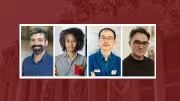
Three Harvard Alumni and a Former Postdoc Named MacArthur Fellows

A labor economist, an organic chemist, a physicist, and a memory researcher were honored with 2026 “genius” grants.

At Harvard’s IOP, Two Views of Diversity Get a Hearing

Professor Cornell William Brooks and Heritage Foundation president Kevin Roberts hold a lively debate on DEI and Project 2025.

Harvard Graduate Students Union Begins Strike Authorization Vote

Amid contract negotations, two unions are discussing a joint walkout this fall.

Most popular

Mindfulness—the unconventional research of psychologist Ellen Langer

Psychologist Ellen Langer's unconventional research. Plus, read about applying mindfulness techniques to eating.

Harvard Weathers a Year of Turmoil

The federal government has launched unprecedented actions against the University. Here’s a guide.

China’s Excess Wind Energy

Rather than shutting down turbines, China can harness surplus wind energy to make “green” hydrogen fuel and industrial chemicals.

Explore More From Current Issue

Colorful word cloud with various emotions and ideas related to learning and reflection.

But it can’t replace human connection.

Decorative wrought iron gate framed by leafy branches, captured in sepia tones.

Former Indiana University president Thomas Ehrlich looks back on curriculum, co-education, and other major trends.

A busy classroom filled with students working at computers, colorful decor, and a bright atmosphere.

In 2004, a frenzy spread across Harvard Yard in days. Four billion users later, we are only just catching up.