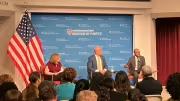
Inaugural Addresses Then and Now

An archival look at presidential inaugural talks, and a contemporary, amusing historian's take on the often-clunky, but increasingly populist, first-day rhetoric.

Michael S. Oberman, J.D. '72, a New York attorney, reminds us that "My Fellow Citizens...," his exhaustive look at U.S. presidential inaugural addresses appeared in these pages in January-February 1977.

Jill Lepore, Kemper professor of American history and chair of the history and literature program, takes a more light-hearted look at the form in "The Speech," published in the January 12 issue of the New Yorker. She finds an evolution in presidential concerns, from a focus on adhering to the Constitution toward a more populist form of appealing directly to the American people. And she discovers unexpectedly affecting eloquence in the address made by James Garfield, elected in 1880, who concluded as follows, in a passage that resonates for January 20, 2009:

My countrymen, we do not now differ in our judgment concerning the controversies of past generations, and 50 years hence our children will not be divided in their opinions concerning our controversies. They will surely bless their fathers and their fathers' God that the Union was preserved, that slavery was overthrown, and that both races were made equal before the law. We may hasten or we may retard, but we can not prevent, the final reconciliation.

Lepore is coauthor of a new historical novel, Blindspot, covered in the November-December 2008 Harvard Magazine.
Related topics

You might also like

A new book explores the Harvard-trained architect’s vision and impact, from Ground Zero to the Smithsonian.

Plus, veteran higher education leader Thomas Ehrlich reflects on university curricula for his 70th reunion

In 2004, a frenzy spread across Harvard Yard in days. Four billion users later, we are only just catching up.

Most popular

The stakes are high for this husband and wife: one of them will die if they don’t find a cure.

A former Harvard College writing tutor changes her mind on LLMs.

Professor Cornell William Brooks and Heritage Foundation president Kevin Roberts hold a lively debate on DEI and Project 2025.

Explore More From Current Issue

Three hands hold smartphones displaying social media profiles with likes and hearts.

Tell us about how social media impacts your daily life.

Caricature of a young man in front of red doors, wearing a green striped sweater.

In 1954, Gregory Corso moved into Eliot House. How he stayed there is a literary legend.

A busy classroom filled with students working at computers, colorful decor, and a bright atmosphere.

In 2004, a frenzy spread across Harvard Yard in days. Four billion users later, we are only just catching up.