Bill Gates urges Harvard students toward public service

In a speech at Harvard, Gates exhorts students to commit their energies to solving the world's most pressing problems. Plus, audio from a conversation with Gates.

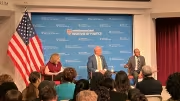
Bill Gates on stage at Sanders Theatre. He visited as part of a three-day tour of universities across the United States designed to inspire students and scholars to focus on the biggest problems facing humanity.

Bill Gates on stage at Sanders Theatre. He visited as part of a three-day tour of universities across the United States designed to inspire students and scholars to focus on the biggest problems facing humanity. | Photograph by Justin Ide/Harvard News Office

Listen
as deputy editor Craig Lambert talks with Bill Gates about education, public
service, success, and satisfaction.

[video:https://harvardmagazine.com/sites/default/files/media/bill_gates_interview.mp3]

Microsoft founder Bill Gates ’77, LL.D. ’07, one of Harvard's best known dropouts, spoke to a large crowd of students at Sanders Theatre on April 21. In a talk titled "Giving Back: Finding the Best Way to Make a Difference," he asked, "Are the brightest minds working on the most important problems?" and exhorted the audience to tackle areas like poverty, energy, food productivity, sustainability, and especially, global health and American education. (The Bill and Melinda Gates Foundation, which has become Bill Gates's primary responsibility since he stepped down as Microsoft CEO two years ago, accents global health and education in its work.)  

Gates showed a chart tracking a steady decline, over the past 50 years, in the number of children under five years of age who perish annually worldwide, and noted that even though economic gains, seen in rising gross domestic products, have affected this by improving nutrition, the lion's share of the change came from vaccination. He pointed out that since 1975, in American public education, "there's been no improvement, and other nations are doing better than we are," despite the fact that per-capita U.S. expenditures on education are considerably higher than those of other countries. Gates said an important under-researched question is: What makes a great teacher? Before his talk, he made a surprise appearance at a Teach for America reception at the Graduate School of Education. In his Sanders remarks, he noted with approval that 324 Harvard seniors, no less than 18 percent of the class, had applied to Teach for America. 

A report in the Boston Globe's business section detailed some of his views on commercial questions as well as public-health initiatives; the Harvard Crimson's story also recounted some of his interchanges with audience members.
Related topics

You might also like

Three Harvard Alumni and a Former Postdoc Named MacArthur Fellows

A labor economist, an organic chemist, a physicist, and a memory researcher were honored with 2026 “genius” grants.

At Harvard’s IOP, Two Views of Diversity Get a Hearing

Professor Cornell William Brooks and Heritage Foundation president Kevin Roberts hold a lively debate on DEI and Project 2025.

Harvard Graduate Students Union Begins Strike Authorization Vote

Amid contract negotations, two unions are discussing a joint walkout this fall.

Most popular

Harvard Weathers a Year of Turmoil

The federal government has launched unprecedented actions against the University. Here’s a guide.

Mindfulness—the unconventional research of psychologist Ellen Langer

Psychologist Ellen Langer's unconventional research. Plus, read about applying mindfulness techniques to eating.

Lafayette’s Unexpected Gift to George Washington: Pheasants

The two birds will be on display at Harvard this summer.

Explore More From Current Issue

A vibrant illustration of a red car parked, surrounded by cheerful people and historic buildings.

Derek Bok donated his car for a good cause.

A smiling William C. Kirby in a suit with glasses stands outdoors, surrounded by greenery.

The president of Harvard Magazine’s Board of Directors will step down in September.

A glowing bulb shape surrounded by colorful, swirling energy lines against a blue background.

Harvard researchers achieve medical breakthroughs in cancer therapy and infection control.