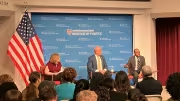
Harvard Business School’s class day speaker, Kathy Giusti, M.B.A '85, a former alumni achievement award winner at the school, has turned her personal experience, following her diagnosis with multiple myeloma (a fatal cancer of the plasma cells) in 1996, into her new profession, as founder and CEO of the Multiple Myeloma Research Foundation (MMRF) and its sister organization, the Multiple Myeloma Research Consortium. The organizations, under Giusti’s leadership, have raised well over $100 million to promote research to address the disease.
In essence, Giusti has found a way to channel privately raised funding into targeted, focused research meant to accelerate the development, clinical testing, and approval for use of new treatments for her disease. Her business background (at Merck, Gillette and Searle), her M.B.A. training, and of course her personal situation have all driven her approach, which is now being emulated for other, similar causes.
Recanati professor of medicine Jerome E. Groopman (read the Harvard Magazine profile)—a hematologist and oncologist—in 2008 devoted one of his New Yorker medical columns, “Buying a Cure,” to Giusti and her business model. He quoted her as saying of the existing approach to medical research, “We’re still learning as we try to change the system. To understand how to cure patients, we are going to have to break down a very broken system.” Groopman agrees with that sentiment, to a degree: for diseases, like multiple myeloma, where the basic biology is relatively well understood, and where the economics of drug discovery are hampered by companies’ search for therapies that apply to larger patient populations.
But for basic biological research, where fundamental knowledge is still needed, he conveys some skepticism: “’Research is not just connecting the dots,’ a prominent scientist who receives funding from the foundation told me. ‘You need creative latitude.’” Groopman quoted Todd Golub, professor of pediatrics, who runs a foundation-funded myeloma genomics project in which the Broad Institute is a partner, as admiring Giusti for promoting notions of accountability, transparency, and collaboration, while also cautioning that researchers need to balance very applied science with more basic, exploratory inquiries: “You need to find the sweet spot between just lobbing money over the fence versus believing we know everything that needs to be done.”