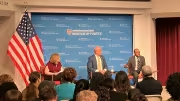
President Drew Faust has been nominated for election to the board of directors of Staples, Inc., the office-supplies retailer. She appears to be the first sitting Harvard president to agree to serve on a corporate board. (Lawrence H. Summers served in an advisory capacity to Taconic Capitol Advisors LP, a hedge fund, from 2004 to 2006, the last two years of his presidency—but not as a fiduciary board member.)
University presidents are often sought after for such service, given their academic and managerial perspectives:
- Brown University’s leader, Ruth J. Simmons, Ph.D. ’73, LL.D. ’02, was a Goldman Sachs director for a decade (a post that became controversial during the financial crisis and the subsequent controversies over compensation and bonuses on Wall Street); she also served on the Pfizer board, and remains a Texas Instruments director.
- As an extreme example, Shirley Ann Jackson, LL.D. ’06, president of Rensselaer Polytechnic Institute, is currently a director of IBM, FedEx, Marathon Oil, Medtronic, and Public Service Enterprise Group (and has held other corporate-board seats)—a set of commitments that raised questions about demands on her time, and on her cash and stock compensation from such work (totaling a reported $1.4 million in 2009).
- Susan Hockfield, of MIT, sits on the General Electric board and is a director of several nonprofit organizations.
- Yale's Richard Levin is on the American Express board.
- And Stanford’s John Hennessy, an electrical engineer who started a computer company when he was a professor, has been a director Google, one of the prominent companies launched from that university, since 2004, and of Cisco.
A corporate directorship may be useful for an academic leader in providing insight to a different sort of organization and its processes and procedures. Faust, having led significant changes in Harvard’s governance through the enlargement of the Corporation announced in 2010 and subsequent creation of substantive committees with broadened membership and expertise, may be particularly interested in such perspectives now, as the University continues to work on streamlining its administrative and financial systems and policies in the wake of the 2008-2009 financial crisis.
Corporate board service, on the other hand, can be a demanding time commitment, in return for which directors are compensated significantly. According to its 2011 proxy statement, Staples paid its outside directors approximately $300,000 each for their service in fiscal year 2010: $75,000 in cash, with the remainder in stock and option awards.
In this instance, Faust is assuredly busy, and can perhaps expect to become even more so as the Harvard capital campaign, now in its quiet fundraising phase, ramps up—but Staples is headquartered nearby, in suburban Framingham, minimizing travel time for board meetings.
That location in part reflects the firm's very strong Harvardian ties. The company was established in 1986 by Thomas G. Stemberg ’71, M.B.A. ’73—now a venture capitalist and passionate Harvard basketball supporter (but no longer affiliated with Staples). It has been in the political news this past winter and spring as Mitt Romney, M.B.A. ’74, J.D. ’75, the leading candidate for the Republican presidential nomination, has cited Staples as a job-creating venture investment made by Bain Capital, the private-equity enterprise he founded, and the basis for his considerable fortune. (Staples' origins and its many Harvard connections were touched upon in a 2001 feature, "Who Wants To Be an Entrepreneur?")
In a statement about standing for the Staples directorship, Faust said, “After five years as president I feel comfortable making a commitment to serving on another board where I can gain additional insight that might be beneficial to my role at Harvard.”