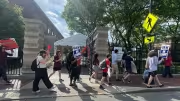
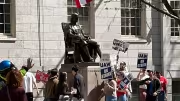
Harvard could soon be facing multiple simultaneous labor strikes, after two more campus unions took steps this week toward work stoppages. On Tuesday, the University’s dining service workers, who have been working without a contract since June, voted overwhelmingly to authorize a strike, though no date was set for a walkout. That vote came a day after the union for non-tenure-track faculty, which is still seeking its first contract, announced that its members would walk off the job on November 10, barring an agreement before then with the University.
These developments followed last week’s decision by the graduate workers union to set a strike deadline of Tuesday, October 27.
For all three unions, pay and benefits are core issues. Carlos Aramayo, the president of UNITE HERE Local 26, which represents nearly 900 campus dining workers, said in an interview this week that Harvard’s wages have fallen behind those of peer institutions. Full-time workers at the University earn slightly more than $30 per hour, or less than $46,000 annually, since most dining service employees work only during the school year. Part-time workers make closer to $18,000 a year. The wage for dining workers at Northeastern University is about a dollar higher per hour, according to the union; at MIT, it’s $5 higher.
“For many, many, many years, Harvard had a wage scale significantly above other universities and colleges in the Boston area,” Aramayo said, “and that’s frankly no longer the case.”
Also, Harvard dining workers cannot apply for state unemployment benefits during the summer, because they work directly for the University and technically remain employed all year. At many other institutions, dining services are handled by third-party corporations, through contracts that allow workers to collect unemployment during idle months.
The union’s third major issue is the rising cost of health insurance. “There’s going to have to be some adjustment on the cost-sharing [between Harvard and its dining workers],” Aramayo said. “People don’t want to get a wage increase and then use all of that wage increase to keep their healthcare.”
In a statement, a Harvard spokesperson said that the University had offered a wage increase of 6.9 percent between now and July 1, 2027—which would bring the average hourly wage to just over $32 an hour—and an increase of 18.7 percent over six years. “We believe that a strike is unwarranted and ask union leadership to continue meeting in good faith to reach a deal soon,” the statement said, adding that Harvard was awaiting a response to its latest wage proposal. “The University remains hopeful that we can advance collaborative discussions at the bargaining table about a mutually beneficial contract that provides the sustainable, long-term stability we want our dining workers to have.”
This week, 89 percent of union members who cast a ballot approved a strike. That does not mean a strike will definitely happen, but the vote gives the bargaining committee the power to call one at any moment. The union last went on strike in 2016, winning a new contract after a three-week walkout that shut down half of the University’s undergraduate dining halls. Students helped organize support for that strike, and this week The Crimson reported that more than 1,000 undergraduates had signed a petition launched in September, backing dining workers’ demands.
Meanwhile, the union representing non-tenure-track faculty—which voted in July to authorize a strike—this week stepped up its threats by setting a November 10 strike deadline, although union leaders said they hope to avoid a walkout.
Certified in 2024, Harvard Academic Workers-United Auto Workers (HAW-UAW) represents roughly 2,500 employees across a broad range of positions, including lecturers, preceptors, instructors, postdoctoral fellows, teaching assistants, research associates, adjunct faculty members, and law clinic staffers. The union is still negotiating for its first contract, and Julien Foriel, a member of the bargaining committee, described recent meetings with the University as “a mix of fruitful, detailed discussion and then stubborn positions, where the University administration is stuck.”
In a statement after the union announced the strike deadline, a Harvard spokesperson wrote that the University “continues to engage in good faith negotiations,” adding, “We feel the two sides have made significant movement toward an agreement…Both sides are exchanging proposals in almost every bargaining session, narrowing the differences between them. We remain committed to the negotiations at the table and do not believe a strike is warranted or necessary.”
Indeed, on several key issues, Foriel said, the two sides are close to an agreement. Perhaps the most momentous relates to time caps, which currently force non-tenure-track faculty members to leave the University after a maximum of two, three, or eight years of employment, depending on the job. The union strongly opposes these limits, and Foriel said that in recent bargaining sessions, the University showed a willingness to eradicate them. “We are confident that after ratification of this contract, time caps will not exist at Harvard anymore,” he said, “and non-tenure teaching faculty will have the possibility of a long-term career here.”
Foriel said that Harvard has also moved closer to union demands for pay parity among postdoctoral fellows—currently, postdocs at Harvard Medical School earn much more than those at the Faculty of Arts and Sciences, despite doing work that requires similar levels of skill and training. Foriel also said that the University had agreed to give international workers more flexibility in determining what type of visa would best suit their needs.
But several major sticking points remain, primarily related to pay and benefits. Workers’ salaries have been frozen for two years, Foriel said, and even before that, “our wages were not keeping up with inflation.” An isotope geochemist, he has worked at Harvard for eight years and is now a research scientist in the Department of Earth and Planetary Sciences. “It’s really insulting,” he said, “the feeling that the longer we work here, the less paid we are.”
The University’s most recent compensation offer, put forward on October 19, would give union members a 3.5 percent raise upon ratification, and a 15.75 percent raise over six years.
The union is also asking for increased child care benefits, a stronger grievance process for issues of discrimination and harassment, and retirement benefits for postdoctoral fellows, who often stay in their positions until their mid- or late 30s, past the age when many other professionals expect to begin saving for retirement. The University and HAW-UAW also remain at odds over how many workers are eligible for union membership—Harvard wants to exclude hundreds of positions that union leaders believe belong in the union.
Still, Foriel said, he hopes to resolve the remaining issues without a strike. “The bargaining process works,” he said. “We hope that we can reach a deal. We all want to keep doing our work. But if administration will not give us the basic demands that we have, we will have to strike, and we will.”