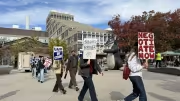
After its members voted earlier this month to authorize a strike, the Harvard Graduate Students Union-United Auto Workers (HGSU-UAW) announced Friday morning that a walkout would begin October 27.
“We want to reach an agreement, not go on strike,” Sarah Johns, a member of the union’s bargaining committee, said in the union’s announcement. “But Harvard continues to deny us the pay and protections we need to do our jobs safely and make ends meet.”
The union, which has been without a contract since June 2025, represents more than 4,000 workers, including graduate research assistants and instructors, along with graduate and undergraduate teaching fellows and course assistants. The new strike would come just a few months after a previous work stoppage. Last spring, HGSU-UAW staged a 40-day walkout—the longest in union history—that disrupted the final weeks of the semester and several Commencement events. The strike was called off as the summer began, without a new contract in place. Afterward, both sides returned to the bargaining table and, according to union president Denish Jaswal, made significant progress on some key issues during discussions over the summer. But since the start of the fall semester, negotiations have stalled again.
Eighty-eight percent of HGSU-UAW members voted to authorize the strike, in a vote that closed October 6.
The University has warned that the new work stoppage may not qualify for labor law protections, arguing that it is an “intermittent” strike, in which union members coordinate to stop work repeatedly as a strategy. Union leaders have rejected that characterization, arguing that the new walkoff would be a second, protected strike, not a continuation of the first one.
The union has been negotiating for higher compensation and benefits, a stronger grievance process for harassment and discrimination complaints, and more support for non-citizen workers, who have come under increased threat during the Trump administration. In a bargaining session last week, Harvard officials made a new compensation offer that would increase union members’ compensation by 6.1 percent upon ratification and by roughly 16 percent over the life of the contract. But union members have said that raise is not enough and that negotiations over the other bargaining issues have been at a standstill. In an interview last Friday, October 16, Jaswal said that one stumbling block is a disagreement over a collection of benefit funds—for child care, healthcare, dental care, and other needs—which she said the University has proposed cutting.
In a statement emailed to Harvard Magazine on Monday, October 19, a University spokesperson pointed to the pay raise offer Harvard has made, as well as other bargaining movements. “We have also made significant progress in other key areas identified by the Union, including expanded benefits coverage for all PhD students, plus expanded benefits for all students through emergency hardship funds,” the University spokesperson wrote. “These are just a few reasons why the University feels a strike is not warranted. However, we continue to meet in good faith with the HGSU bargaining leadership and remain committed to reaching an agreement.”
In an interview on October 16, Jaswal said that union leaders “want to do everything in our power to avoid a strike.” She added that the union continues to propose possible compromises to Harvard officials. “We understand the sacrifice and impact that [a strike] can cause the University community. We’ve offered the University more sessions,” she said. “We’re willing to meet day and night to reach an agreement if that’s what it takes. And, so, we’re hopeful that the University will take up our offer and come to the table so that we can have a fair deal for our workers.”
Another bargaining session between HGSU-UAW and the University—the 38th since negotiations began in 2025—is scheduled for October 22. If the two sides cannot come to an agreement in that meeting, union leaders said in their announcement, the strike will go forward.
This is a developing story. Updated 3 p.m. EDT on October 20, 2026.