Members of the Harvard Graduate Students Union-United Auto Workers (HGSU-UAW) overwhelmingly authorized a strike this week, as union leaders continue to negotiate with the University over pay, benefits, and worker protections. In a statement on Wednesday, the union announced that 88 percent of its membership had voted in favor of a walkout. The vote does not automatically trigger a strike, though, and HGSU-UAW president Denish Jaswal said on Thursday that she still hoped to avoid that outcome.
“We are hopeful that we do not have to strike in order to reach a fair contract,” Jaswal said. “We are doing everything in our power to meet with the University and make movement on proposals and efforts to avoid a possible strike.”
The union, which has been without a contract since June 2025, represents more than 4,000 workers, including graduate research assistants and instructors, along with graduate and undergraduate teaching fellows and course assistants. The new strike threat comes just four months after a previous work stoppage. Last spring, HGSU-UAW staged a 40-day walkout—the longest in union history—that disrupted the final weeks of the semester and several Commencement events. The strike was called off as the summer began, without a new contract in place. Afterward, both sides returned to the bargaining table, but in recent weeks, Jaswal said, negotiations had stalled again.
The University has warned that a new strike may not qualify for labor law protections. In an October 2 letter to union leaders, Paul Curran, the managing director of Harvard’s Office of Labor and Employee Relations, wrote, “Federal labor law does not protect intermittent strikes—that is, strikes that start, end with members returning to work, and then restart in support of the same goals.” If the strike were unprotected, HGSU-UAW members would be subject to disciplinary action or dismissal for not performing their work.
“When HGSU unconditionally ended the strike last spring, it stated publicly that its ‘fight’ for a new contract was not over and that it was prepared to strike again,” Curran’s letter to the union said, adding, “You confirmed at the bargaining table that a second strike would be in support of the same issues from the first strike.”
Jaswal disputed the idea that a new work stoppage would not be protected by law. She cited a 2019 ruling by the National Labor Relations Board (NLRB) that defined intermittent or “repetitive” strikes as a coordinated strategy by employees to strike and then return to work before striking again. “Any suggestion that HGSU has ever made such a plan is patently false,” Jaswal said.
The NLRB ruling distinguished intermittent strikes from the decision to strike a second time if circumstances warranted it, even if based on the same demands. Jaswal said that the union considers its recent actions to be preparation for a second, protected strike, not a continuation of the first one. “We called off our last strike when the University finally began to bargain in good faith,” Jaswal said, “but over the summer and into the fall there has been little meaningful progress at the table.” The three bargaining sessions immediately preceding the strike authorization vote yielded no new proposals from the University, Jaswal said.
Union leaders have been negotiating for higher compensation and benefits, a stronger grievance process for harassment and discrimination complaints, and more support for non-citizen workers, who have come under increased threat during the Trump administration.
Late Thursday afternoon, HGSU-UAW leaders held another bargaining session with Harvard, the 37th the two sides have had since the union’s contract expired in 2025 and the first since the strike authorization vote took place. The University brought three new proposals to the table, Jaswal said (and a Harvard spokesperson confirmed), including a pay raise. The new offer would increase union members’ compensation by 6.1 percent upon ratification and by roughly 16 percent over the life of the contract, according to the University spokesperson. Harvard’s proposal would also bring hourly wages for teaching fellows in line with those of research assistants. Currently, many teaching fellows earn much less than research assistants, and addressing that disparity has been a central goal for the union.
Jaswal said that the University pay proposals “still fall far short,” and added that the union has not yet seen new proposals on other bargaining goals, including harassment and discrimination protections, non-citizen worker rights, and benefit funds to offset the cost of childcare, healthcare, immigration expenses, and emergencies.
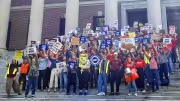
If the union does strike, it may be joined by the Harvard Academic Workers-United Auto Workers (HAW-UAW), whose members authorized a strike in July. Representing more than 3,000 non-tenure-track faculty and other academic employees, HAW-UAW, which was certified in 2024, is still bargaining for its first contract. Among its negotiating demands is the removal of time caps that limit many teaching appointments to a maximum of eight years. In late September, the two unions rallied together outside Zimmer Hall. Another joint rally took place on Harvard’s Longwood campus.