 |
| Photograph by Jon Chase |
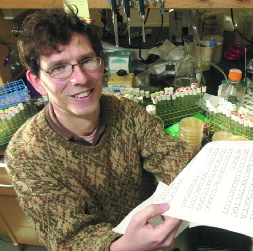
One week after publication of the human genome, Andrew W. Murray, professor of molecular and cellular biology and director of the Bauer Center for Genomics Research, reins in expectations. Yes, DNA sequencing "gives us the possibility of looking simultaneously at, say, all the messenger RNA in a cell," and hence at the fabrication of the myriad proteins involved in cell function and life itself. On the other hand, biologists risk inundation by a tidal wave of data, divorced from meaning and knowledge: Murray offers the analogy of receiving the text of Shakespeare's works, but not the key to its orthography, diction, grammar, punctuation, or meaning. What's more, "We are much more ignorant than we realize about biology." Untangling further mysteries falls to researchers like Murray, a slight and casual man with a Medusan tangle of brown hair. Although an ancestral New Englander, his voice reflects an upbringing in England and undergraduate education at Clare College, Cambridge. After earning a Ph.D. at Harvard Medical School on chromosome behavior as brewer's yeast reproduces, and 15 years at the University of California at San Francisco, he returned east last summer. Here, Harvard's first genomic fellow is designing tools to assess protein structure and function. In his own laboratory, Murray still works on the steps in cell division--the mechanisms that assure "you put on your socks before your shoes"--and attempts to cause yeast to speciate when perturbed, making evolution an experimental fact. Elsewhere, he indulges in old-fashioned black-and-white large-format photography, and secures his own socks with reflective tapes when bicycling to campus from Brookline Village, where he and his wife dote on their young daughter.