|
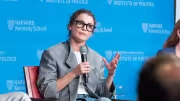
| Jacqueline Bhabha |
| Photograph by Stu Rosner |
Even as a newborn in Bombay in 1951, Jacqueline Bhabha was involved in refugee issues: her parents were German Jews who fled Nazism. “I’m an activist at heart,” she declares, but Bhabha is also a lawyer, scholar, and executive director of the University Committee on Human Rights Studies. She teaches international refugee law at the Law School, and offers a freshman seminar and Kennedy School courses on human rights. In 2000 she launched Scholars at Risk, a program that helps academics facing persecution find temporary (usually one-year) safe havens in American universities. Much of Bhabha’s current legal work aims to expand the scope of international refugee law to encompass the persecution of children. “These laws were framed by adults, for adults,” she explains. She’s haunted by the memory of an orphanage in India, where she saw children who had been maimed by their parents to increase their effectiveness as beggars. Her next book will explore the plight of children who cross international borders without parents or guardians, such as victims of child trafficking. Bhabha, who speaks six languages, grew up in Bombay until she was 10, when her family moved to Milan and she “became an Italian kid.” Next she matriculated at Bedales, a British boarding school, and Oxford, where she earned a first and met her husband, Homi Bhabha, now Rothenberg professor of English and American literature and language. The couple moved from Oxford to the University of Chicago in 1994, then came to Harvard in 2001. Bhabha enjoys tennis, swimming, and especially their three children who, whenever possible, like to cite their parents for “human-rights violations” at home.