Harvard University Press closes its display room

The Harvard University Press display room closes its doors.

Photograph by Jim Harrison

Photograph by Jim Harrison

Parker, Flemming, and Duncan ran a sophisticated bookstore in the heart of the Square.

Parker, Flemming, and Duncan ran a sophisticated bookstore in the heart of the Square. | Photograph by Jim Harrison

Photograph by Jim Harrison

Photograph by Jim Harrison

Photograph by Jim Harrison

Photograph by Jim Harrison

[extra: Photo Archive]

See photos from HUP display room history.

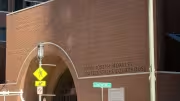
The display room of Harvard University Press (HUP)—a fixture in the Holyoke Center arcade since 1966—and before that, on Dunster Street since 1948—closed on June 17. The proximate cause was the decision by two of the three employees, manager Jeff S. Flemming ’73 and Marygail Parker, to accept the University’s early-retirement program; their third colleague, Barry Duncan, was among the Press staffers laid off. The staffing transition came at a time when book sales have declined (in common with retail sales generally)—putting pressure on the Press, which operated the display room more as a customer service and a publicity venue than as a money-making venture. (Longer term, of course, book sales have also increasingly migrated to electronic outlets; Amazon is HUP’s largest customer.)

The books themselves remain readily available, and HUP’s list can be browsed comprehensively at its website, www.hup.harvard.edu. What is lost, however, is the overwhelming visual impression of the whole Loeb Classical Library in its green (Greek) and red (Latin) cases and dust jackets, and the nearby bright blue of the newcomer, the I Tatti Renaissance Library. It becomes more difficult to assemble, at a glance, the depth of the works published in Slavic studies, or in higher education, or music, or landscape architecture. This was a sturdy place—brick floors, concrete ceiling, solid shelves—in which to encounter Igor Stravinsky and Eudora Welty, among all the scholarly volumes. Above all, as showed by the store’s sign—a stack of books disordered by rummaging, rather than positioned neatly but unopened—it was a place about serious reading and publishing: a very good thing for a university-press bookstore embedded in the center of Harvard’s campus.
You might also like

The popular Harvard English professor published Under Water this spring.

Author and Harvard Divinity School writer-in-residence Terry Tempest Williams finds beauty in the world around us.

All That’s Unseen charts the Harvard graduate’s uneasy journey from Appalachia to Cambridge and back.  

Most popular

Harvard’s Class of 2029 Reflects Shifts in Racial Makeup After Affirmative Action Ends

International students continue to enroll amid political uncertainty; mandatory SATs lead to a drop in applications.

The Harvard graduate’s roundtable talk show touches on hot button issues from religion to sex. 

In 1954, Gregory Corso moved into Eliot House. How he stayed there is a literary legend.

Explore More From Current Issue

Three young women posed side by side against red background.

The 2026-2027 Ledecky and Summer Undergraduate Fellows

Decorative wrought iron gate framed by leafy branches, captured in sepia tones.

Former Indiana University president Thomas Ehrlich looks back on curriculum, co-education, and other major trends.

Colorful cartoon animals, including dogs, cows, rabbits, and a fence, on a pink background.

Inseparable cows, big dogs fostering a tiny kitten, and a show beagle’s second act