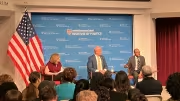
Addressing the Faculty of Arts and Sciences (FAS) on February 2, Dean Michael D. Smith presented “Recommendations and Next Steps” for the continuing effort to “bring annual expenses in line with the current financial situation we find ourselves in,” while enabling the faculty to pursue future priorities.
He cast that effort in an encouraging context: FAS is near a goal of reducing its unrestricted deficit for this fiscal year (ending June 30) from $20 million to essentially break-even results. Further, it expects to reduce the gap looming over the next fiscal year from $110 million to an unrestricted deficit now estimated at $80 million, thanks chiefly to a revenue item: a change in Massachusetts law last year permits institutions to avail themselves of income from “underwater” endowments (where principal has declined below the gift amount because of investment losses like those sustained by Harvard’s endowment last year).
Nonetheless, Smith said, the remaining “huge” deficit will not be eliminated by actions being taken now or envisioned in the near term. His goal by the end of this fiscal year is to put FAS on a budgetary path that enables it to operate in a sustainable (non-deficit) way by fiscal year 2012. He forecast that FAS’s unrestricted reserve funds would bridge the excess of expenses over available income in fiscal year 2011 and part of the next year before running out.
Smith summarized—without dollar figures—the ideas for further efficiencies and improvements in FAS operations generated by the six working groups he established last year (for arts and humanities; social sciences; sciences; engineering and applied sciences; College academic life; and College student services). Suggestions from the community at large were also collected at an online “idea bank.”
Among the recommendations he said merited implementation soon are: tools to better gauge students’ likely course selections, so teaching fellows can be hired more efficiently; curricular committees (like the one for the many life-sciences concentrations) that could reconfigure very small, specialized courses in different departments into more intellectually engaging, somewhat larger offerings—with instructional savings; more flexible faculty use of sabbatical leaves—perhaps staggering them so course offerings can be maintained intact (lessening the need for visiting teachers); and using sponsored-research funds to pay faculty salaries during the academic year (not just during the summer), freeing Harvard-paid salary funds for research. For details, see https://planning.fas.harvard.edu/index.html.
This spring, Smith and the leaders of departments and academic centers will engage in a form of financial poker, revising proposals for the fiscal year 2011 budget. Smith is keeping close to the vest data on FAS’s reserves, the size of the deficit he can accept, and how he will allocate central funds that are annually distributed to support academic operations.
In the meantime, FAS faces large financial uncertainties. The Corporation has not yet announced the endowment distribution—the faculty’s largest revenue source by far—for fiscal 2012. (It has been reduced about $50 million during the current fiscal year, and a further $70 million for fiscal 2011.) And administrators will not know until the June 30 election date how many senior faculty members have accepted the retirement incentive offered last December; those decisions, taken together, will affect significantly the future size and cost of the professoriate.