Harvard College announced today that nearly 81 percent of students admitted to the class of 2016, enrolling this coming August, had decided to matriculate. The last time the “yield” reached 80 percent, according to the College news release, was in 1971, for admission to the class of 1975. Last year, 75.9 percent of admitted students enrolled.
The elevated acceptance rate was expected, given the College’s reinstatement of voluntary early-action admissions for this class. Typically, early-action and early-decision candidates are thought to have a very strong interest in attending the institution to which they apply. As reported, the College admitted 774 students (rather than the figure of 772 originally released) under early action last December. With admissions officers expecting a very high yield among those students, the rate of acceptances for the total applicant pool was reduced to 5.9 percent to prevent overcrowding when students matriculate. As one result, according to the release, only about 25 students will be admitted from the College’s waiting list; in recent years, waiting-list admissions have ranged from 0 to 228.
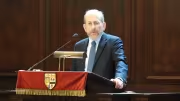
Today’s news release cited “the return of early action” as a leading factor in increasing the yield “so significantly,” according to William R. Fitzsimmons, dean of admissions and financial aid, underscoring the competitiveness of admissions to selective institutions today. As part of early-action acceptances, the release noted, “offering preliminary financial aid awards to students admitted in December gave reassuring news about Harvard’s affordability.”
The news release cited as other factors in Harvard’s continuing appeal to admitted applicants both the general strength of the College’s financial-aid program, and curricular attractions such as the continuing expansion of the freshman-seminar program (offering the opportunity for small-class interactions with senior faculty members in an ungraded setting) and the rising visibility of the School of Engineering and Applied Sciences.
According to the release, as of now, 52.5 percent of the entering class is male. African Americans make up 9.4 percent of the class; Asian Americans, 22.6 percent; Latinos, 9.3 percent; and Native Americans and Hawaiians, 1.7 percent. Some 11.3 percent of the students are international.
Prospective concentrations reflect the relatively modest interest among entering students in the humanities (17.5 percent), compared to the social sciences (29.1 percent) and the broad array of sciences and related fields (24.3 percent in biological sciences, 13.6 percent in engineering and computer sciences, 8.5 percent in physical sciences, 6.4 percent in mathematics). Just 0.6 percent of the entering students recorded themselves as undecided—a fraction that, perhaps, will rise as those new Harvard undergraduates take in unexplored intellectual frontiers in their freshman seminars and other first-year classes.