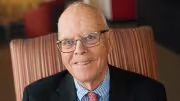
Faculty of Arts and Sciences (FAS) dean Michael D. Smith informed colleagues today that Michael Shinagel will step down as dean of the Division of Continuing Education (DCE)—a role he has filled since assuming leadership of the Office of Continuing Education in 1975. He will continue in his present capacity while FAS conducts a national search for his successor, according to Smith’s message. A note from Shinagel on the search, and a copy of Smith's message, appear here.
Reflecting on the transition, Shinagel said, "I can appreciate how a new leader at DCE will take us through the next 20 years or so, but I need not tell you how bittersweet I feel about leaving the deanship after all these years. One of my favorite quotes is by Confucius, who said: 'If you find work that you really enjoy, you won't have to work a day in your life!' My 38 years at DCE have confirmed this truism every day."
Under Shinagel’s leadership, the division has become a leading center at Harvard for technologically enabled distance education, and for study abroad: Harvard Extension School now offers more than 200 online classes, spanning the disciplines from anthropology to statistics; and Harvard Summer School (which also has a substantial menu of online courses) offers classes in about two dozen international venues. DCE also includes short professional-development programs and the peer-taught enrichment classes of the Institute for Learning in Retirement (ILR). (Read an account of the institute’s retiree learner-teachers here.) Beyond serving a broad community of students of all ages, from around the world, the division has been financially successful for FAS over time, providing an important source of revenue.
In an essay for Harvard Magazine’s issue on the University at its 375th anniversary, in the fall of 2011, Shinagel forecast that “in 2036, the majority of students enrolled at the University will most likely be nontraditional,” perhaps totaling “five or more times the number of traditional residential students in the College and the professional graduate schools.” His forecast, based on the division’s nontraditional learners and the online enrollments at the extension and summer schools (“…a major shift in instruction from the classic large-lecture format to an asynchronous electronic format that can be accessed by students on their computers on campus and globally through online distance education”) may prove to be very conservative; Shinagel was writing several months before Harvard and MIT launched edX, their worldwide online-learning enterprise.
Shinagel’s forward-looking ventures have been rooted in Harvard traditions. He presided over the Extension School’s centennial and is the author of “The Gates Unbarred” A History of University Extension at Harvard, 1910-2009. (Read the Harvard Gazette’s centennial interview with Shinagel.) As Smith’s note summarizes, Shinagel taught a section of freshman English in the fall of 1958 and Expository Writing for four years; he also taught in the Extension School. He earned his Ph.D., from the English department, in 1964. (A specialist in eighteenth-century English literature and the rise of the novel, he has edited editions of and published on Jonathan Swift, Daniel Defoe, and others.) Thereafter, he was on the faculty at Cornell and at Union College before returning to Cambridge for good in 1975. As dean, he founded the ILR in 1977. He has also remained active in teaching, as a senior lecturer on English since 1983: leading undergraduate courses in the College and graduate seminars in the extension school.
Shinagel was Master of Quincy House from 1986 to 2001, and has assumed other administrative duties as well, ranging from service on the Faculty Council to stints as president of the Faculty Club and as co-publisher of the Harvard Review.
Smith said Shinagel would be honored at a community event next spring.