Make way for poults. Visitors to Harvard Yard—and these days, there are throngs of them—often wish to capture an iconic photo: Johnston Gate; the Widener steps; John Harvard’s gleaming toe (about which, see more below). But a surprising number, from other climes, are enchanted by the resident (not very wild) wildlife. University-based squirrels could retire easily, without burying an acorn, if they could collect a nickel per pose for each picture taken.
Of late, the opportuities for such snapshots have multiplied with the arrival of wild turkeys—competitors for those acorns. Some of these large birds patrol Mass. Ave., but most hang out at ground level in the Yard, on the roofs of freshman dorms, etc. Where there are turkeys, inevitably, there are poults, and in the weeks immediately after Commencement a mother and her seven youngsters grazed on the lawn between Lamont and Widener libraries with some regularity. Viewers were agog—including, we must confess, some hard-bitten reporter types from this publication’s staff (read the resulting in-depth report at harvardmag.com/poults-19).
Harvard is, of course, steeped in history, so the newest avian infatuation brings to mind an earlier incident: the duck and her ducklings atop Quincy House in 1996. Then-master (as the position was then known) Michael Shinagel told the reporter on duty, managing editor Christopher Reed, “It just shows to what lengths a determined mother will go to get her children into Harvard,” suggesting that history repeats itself in other ways, too—and the wisdom of nature.
Foot fetishes. Those many visitors to the Yard also, inevitably, huddle around John Harvard, and someone burnishes the favorite, famous toe further, while cameras click (see, for example, harvardmag.com/harvard-china-15). There is no warning sign about the other, disgusting undergraduate tradition associated with the statue, although brief contact with uric acid, in small doses, is not known to be fatal.
Turns out that the tradition of rubbing the statue for good luck is neither rooted in the mists of time nor unique to Harvard. Yale tour guides tell a story about a Crimson-Blue regatta at which Theodore Dwight Woolsey gave the Yale boat a foot nudge at the start of a race, leading to a victory—and the listeners learn that students rub that statue for good luck. (It is unknown whether the guides tell them that Yalies are also rumored to water Woolsey the way their Cambridge counterparts are said to do locally.) Similarly for the immortalized Ben Franklin at Penn.
As the tradition is not unique—and not that traditional, and surely neither healthy for people nor good for the statues—perhaps it is time to give it a rest?
Pleasant prospect. Turkeys, tourists, and traditions aside, Harvard’s campus is often at its loveliest in seasons when students and alumni, ironically, are not resident: early summer, Thanksgiving weekend, during a winter-break snow.
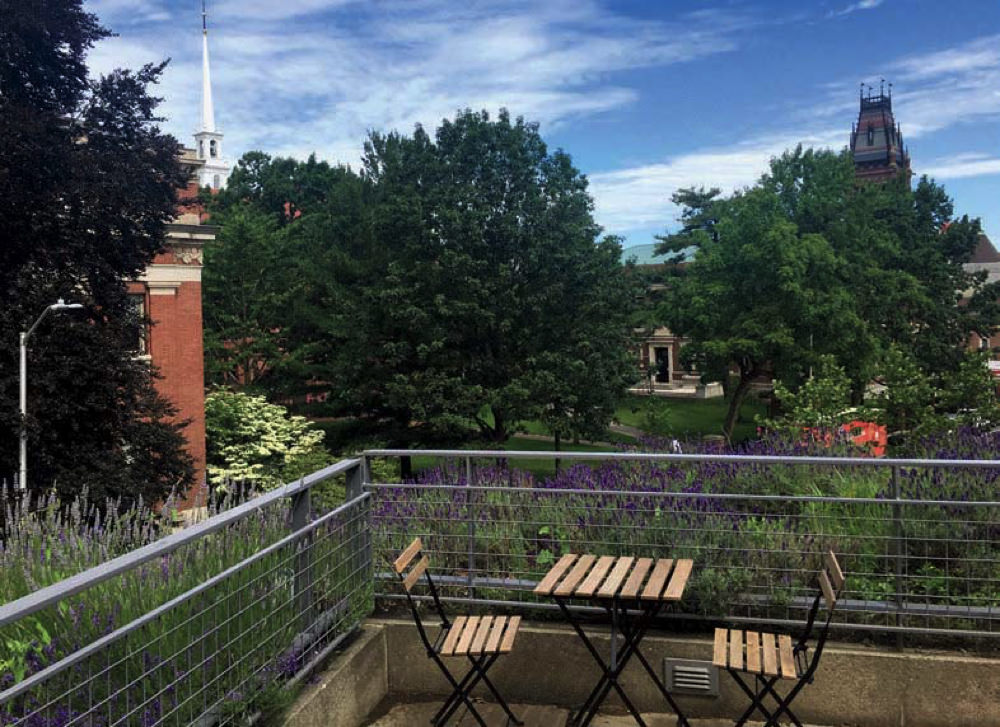
Photograph by Jennifer Carling/Harvard Magazine
One of the best places to veg out during the clement months is the small plaza atop the Carpenter Center’s sweeping ramp overlooking Quincy Street. There is a sometimes-book store, sometimes-gallery space, but not much traffic. There are now tables and chairs, and usually a sitter’s choice of sun or shade. The views of the Memorial Church spire and the restored Memorial Hall tower are simply smashing. And the surrounding, elevated garden space is pleasing if a bit eccentric. At one time, it was planted to tomatoes, but is now largely given over to lavender. To some, the Duke/Yale blue may seem treasonous. But the geometry, the occasional unruly weed (in defiance of Harvard’s careful grooming of its storied landscape), and the contrast with the surrounding leafy canopy of trees are all just right.