Taking advantage of the pandemic-induced reduction of activity in Harvard Square, the Harvard Coop has closed its main store to accomplish a major renovation in one concerted effort. “We’re bringing it back to its bones,” said Coop president Jerry Murphy ’73, M.B.A. ’77, during a tour of the bookstore’s overhaul. The construction, which began in mid-December, was originally conceived in several stages to keep the store open even as the work proceeded. But given the intensity of the pandemic late last year, it made more sense to close the store and accelerate the project.
Although the Coop was renovated in 1996-1997, this new project with architect Arrowstreet Inc. will address infrastructure, merchandising, and a consolidation of the retailing now distributed between the main store and the Palmer Street annex—both Coop-owned properties—and the leased space facing Brattle Street. The Coop’s board has yet to decide what the Palmer Street annex will become. Although overall book inventory will be reduced as the operations are consolidated, core genres of books that are most important to Coop customers have been increased while fringe categories have been scaled back, Murphy said.
“The air conditioning, heating, and electricity is shared between our two buildings,” Murphy explained. “We want to separate the buildings and upgrade all the equipment since it’s very old.” (Separating the systems will presumably also make it feasible to decide on a separate use of the annex facility.) The renovated book-selling areas in the main building will include more space for customers to move around and practice social distancing successfully. The renovation will also include installing touchless doors in the front and touchless transactions at the register: new retailing priorities in the COVID era.
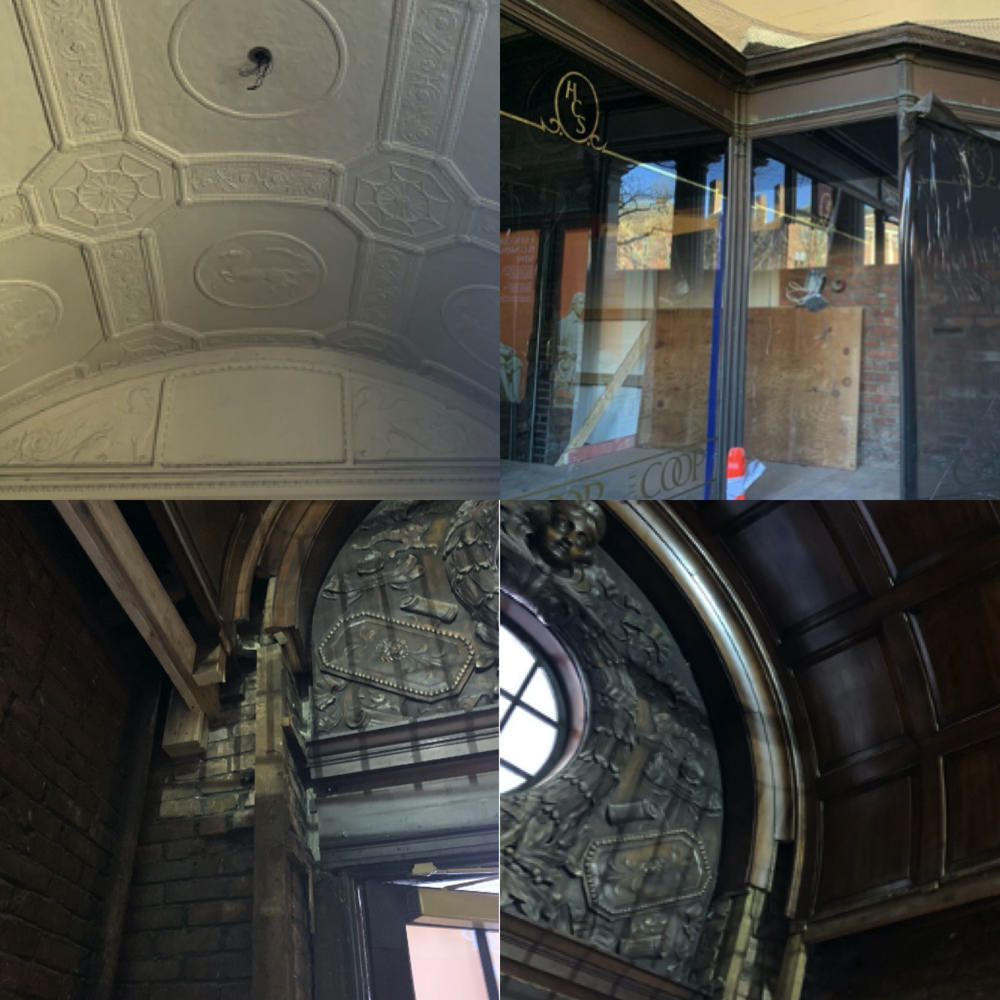
Some of the building’s traditional architecture will be restored to its original glory.
Photograph by Kristina DeMichele/Harvard Magazine.
Architecturally, the work involves renewing the traditional appeal of the facility itself. The Coop purchased the building in 1906 and re-built it in 1925. The foyer will be restored to its original glory. “We’re going to re-do all the lights for the ceiling and install new terrazzo flooring,” said facilities manager John Ciancio. “The chandeliers are being restored by Grand Light, a Connecticut company that specializes in fine lighting restoration. This is beautiful artisan woodwork and artwork here, so we want to bring it back,” too.
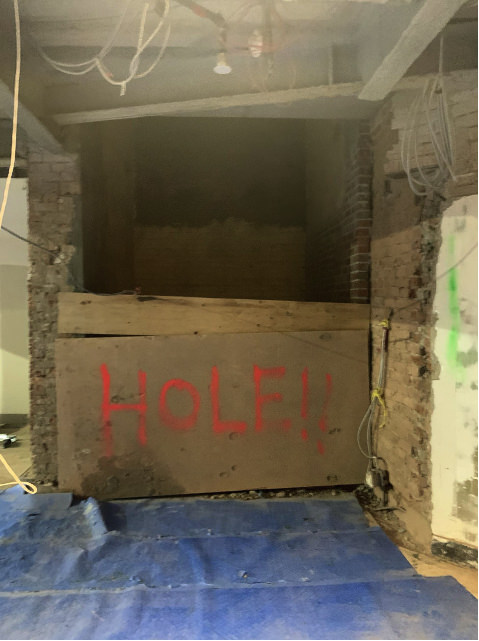
An elevator from the 1920s, out of service for the past two years, once filled this space.
Photograph by Kristina DeMichele/Harvard Magazine.
The original interior floors will also be restored. “When you look at the floor in a certain type of light, you can see where the old showcases used to be,” Ciancio said. “There are indentations in the floor where people used to belly up to the counter.” Additional ceiling lights will make the open space brighter, and the wooden balconies along the second floor will be brightened as well. “The Harvard libraries are doing away with darker wood,” Murphy said, “and you’ll see that same thing here.”
All the Harvard school shields will return and will be hung from the second-floor balcony. The Coop is also retaining the now-iconic photomural along the central spiral staircase, created for the last renovation, that displays both the history of Harvard and the founding of the Coop itself.
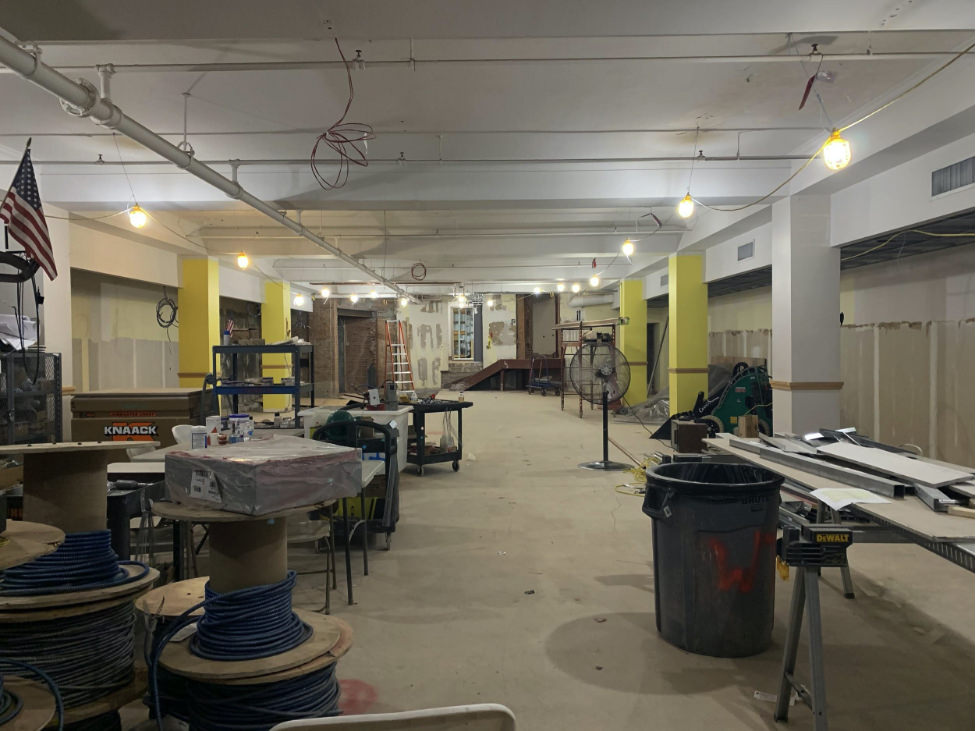
The expanded lower level will contain more Harvard merchandise.
Photograph by Kristina DeMichele/Harvard Magazine.
The lower level—where children’s and young-adult books were displayed before the closure—will contain more Harvard merchandise, while half the main level and the whole of the upper floors will carry the books. The third floor will also include permanent event space, which Murphy hopes to use for both in-person and virtual events. The café has been permanently removed. “We don’t need it,” he said. “You can get a cup of coffee anywhere in Harvard Square these days.” Café removal also means the removal of magazines and journals, but the Coop plans to monitor the situation and will consider selling them again if possible.
Ciancio offered a reflection on the Coop’s history as part of the Square. “We used to be a department store for all of Cambridge. But then the malls were built and the MBTA extended the Red Line, and that changed the dynamics within the Square….Every graduating class has something they remember that isn’t here anymore, but that’s life.”
Renovations are scheduled to be completed by early May. In the meantime, customers can purchase books and Harvard merchandise online, or in person at the Palmer Street building.