 |
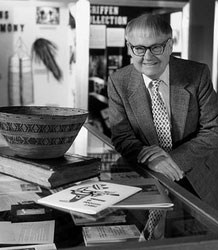
| William H. Jacobsen's research has helped to keep Native American languages alive. |
| Photograph by Peter Walker |
Jacobsen, who relishes distinctive languages like Basque, was drawn to Washo because it had not been studied before by outsiders and because it is unrelated to the other Native American languages spoken in adjacent areas. Among its interesting features, he points out, is the number of verb tenses. There are four past tenses, and speakers can express an intention to perform some action in one of three different future tenses to indicate "in the next hour or so," "later on today, or soon," or "in the more distant future." There are also particular verb forms to express a speaker's relationship to an event, which lawyers and judges might welcome: in Washo a speaker must choose among verbal suffixes expressing the meanings "I saw the event occur," "I didn't see the event, but I saw the result," "I heard something that sounded like the event taking place," or "I heard about the event from someone else." Compared to Washo, Jacobsen observes, "in certain respects English can seem impoverished, or at least lacking in subtlety."
Now professor emeritus at the University of Nevada at Reno, Jacobsen applied to Harvard because of its reputation in classics and philology. "I am grateful to the College for letting me study an esoteric field," he says. "There was only one other classmate who chose to concentrate in linguistics" which at that time had to be combined with a second subject "and one at Radcliffe. But I could take or audit courses taught by world-renowned faculty, and I got to take six graduate courses as an undergraduate."
His first contact with Native American languages occurred in a Harvard social-relations course called "Practical Linguistics for the Social Scientist": the professor brought in a speaker of Navajo and had the students try to figure out a system for writing it down. When Jacobsen moved on to Berkeley, he was pressed into service, like most linguistics graduate students there, on the university's ongoing survey of California Indian languages an urgent project because so many of the languages were near extinction, spoken by only a few elderly people. In his first effort to learn one of the languages, Salinan, Jacobson recalls, his main informant was quite hard of hearing, which "made connected discourse difficult."
Trying to obtain information from a relatively isolated ethnic group can pose its own problems, Jacobsen adds. When he moved on to the University of Washington, he began studying the Makah language, spoken around Cape Flattery. "I decided to start by asking about local place names, as a way to learn basic vocabulary, but apparently that aroused suspicion in some quarters," he says. "I learned that a few people had taken me for a spy trying to get information about a nearby Air Force base." (He persevered, however, and later published First Lessons in Makah.)
Jacobsen's research may seem arcane to many people, but the situation looks different within the Washo community. Ombria Thompson, a teacher's aide at the tribal language school in Dresslerville, Nevada, reports that eight pupils currently attend classes after their regular school day ends for immersion lessons based on Jacobsen's textbook. In all written work, the school uses the system for representing the sounds of Washo that William Jacobsen devised.
~Deborah Schneider