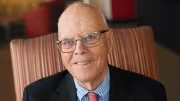
In spite of efforts to break down barriers between faculties and between disciplines, Harvard still suffers from a reputation for being "irretrievably Balkanized," University provost Steven E. Hyman tells Science magazine in the July 11 issue.
In spite of efforts to break down barriers between faculties and between disciplines, Harvard still suffers from a reputation for being "irretrievably Balkanized," University provost Steven E. Hyman tells Science magazine in the July 11 issue.
The article quotes Harvard Overseer Joan Steitz, Ph.D. ’68, S.D. ’92, now a molecular biologist at Yale, as saying: "It's clear that Harvard has lagged behind other universities in making connections within its faculty." And Hyman voices his hopes that the Allston complex will be "like Switzerland"—neutral territory between Cambridge and the Longwood Medical Area in Boston where scientists can meet in the middle.
Even with the Office of Technology Development's work to jump-start technology transfer at Harvard (read more about that from our archives here), Hyman says not enough discoveries are making it from the lab bench to the clinic. "It is not about the money," he says, but about bringing potentially lifesaving discoveries to market. "If you are organized as a community entirely of small curiosity-driven labs, you are not organized to move advances through the pipeline to application," he tells Science.
But Hyman, a neurobiologist who previously directed the National Institute of Mental Health, may not get a chance to see this vision come to fruition, the article warns:
His successful track record in Washington has spawned rumors that he could succeed Elias Zerhouni as [National Institutes of Health] director in either an Obama or a McCain administration.
Those with Science subscription access can read the full article here or find it using this reference: volume 321, number 5886, pages 190-192.