In the Hole

Harvard assesses the feasibility of completing capital projects now under way, and the timing of other parts of its institutional master plan.

Photograph by Stu Rosner

Photograph by Stu Rosner

Photograph by Stu Rosner

Photograph by Stu Rosner

Photograph by Stu Rosner

Photograph by Stu Rosner

For an update posted after this issue went to press, see "Faust: University Will Slow Pace of Construction in Allston."

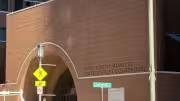
Construction continued apace in early February on the foundations of Harvard’s first science complex in Allston, a roughly 1-million-square-foot, billion-dollar facility slated to house the Harvard Stem Cell Institute (HSCI), bioengineering initiatives, and the University-wide department of systems biology. Workers have been waterproofing the exterior cement walls and erecting the below-grade portions of the structural steel beams and columns for the first of four buildings planned for the site.

Yet a carefully worded University statement in January said that an “assessment of the project and the environment in which it is being developed” continues, a reference to the unfolding financial crisis (see "The Fiscal Crunch"). Emphasizing that “scientific excellence is first and foremost about people and programs,” University spokesperson Lauren Marshall said that even though “changed financial realities have dictated thorough review” of all capital planning, Harvard’s “commitment to interdisciplinary science will be sustained….”

The University’s institutional master plan for Allston, originally expected by the end of 2008, has also been delayed at least in part by pecuniary considerations. Such plans must specify both near- and longer-term construction commitments, implying the need for predictable funding. Marshall emphasized that “Harvard’s long-term commitment to Allston hasn’t diminished....The master planning process continues. We are rigorously evaluating our options and consulting with key stakeholders….” The University, she says, “is carefully considering a range of capital planning scenarios, but no final decisions have been made.”
You might also like

The University has pushed the adoption of AI into teaching and operations, but faculty resistance is growing louder.

The division is launching a new fundraising effort to support 50 additional students.

President Alan M. Garber used traditional Memorial Church address to consider the unique qualities of human intelligence and learning.

Most popular

Harvard Weathers a Year of Turmoil

The federal government has launched unprecedented actions against the University. Here’s a guide.

Harvard art historian Jennifer Roberts teaches the value of immersive attention

Teaching students the value of deceleration and immersive attention

The University will compensate families of those whose remains were sold and establish a scholarship to honor anatomical donors.

Explore More From Current Issue

Three actors perform on stage, with one actor interacting closely with another, set against abstract backgrounds.

The play Spare Parts is a contemporary fable about the quest to live forever.

A busy classroom filled with students working at computers, colorful decor, and a bright atmosphere.

In 2004, a frenzy spread across Harvard Yard in days. Four billion users later, we are only just catching up.

Runners compete on a track, with a Harvard athlete in the foreground and others behind.

After a historic 2025-26 season, athletes eye NCAA championships.