
On a recent Tuesday afternoon, Pardis Sabeti was not in her office at Harvard’s Center for Systems Biology, but en route to Manhattan—to play a gig that night at a club in the Meatpacking District with Thousand Days, the alternative-rock band for which she sings lead vocals and plays bass guitar. Though such weeknight gigs are rare and Sabeti admits she would choose science over music if pressed, the latter does not detract from her duties as assistant professor of organismic and evolutionary biology; the interaction, she says, is multiplicative, not subtractive. She keeps a guitar in her office to capture the songs that sometimes spill over during spells of scientific creativity. It was during just such a bout of “flow” that Sabeti made a landmark discovery in genetics. As a Rhodes scholar at Oxford in 2000, she was investigating a basic tenet of the field—that evidence of natural selection should be detectable on the human genome because beneficial variants spread quickly through populations. Many were searching for a way to find this evidence in the new data made available by genome sequencing; Sabeti was the first to devise a method, and her algorithm is now used routinely to identify areas of interest on the genome for further study. It was also at Oxford that she taught herself to play the guitar so she could help friends form a band. Aside from dabbling in piano lessons as a child, she had never before played an instrument, but, she says, she had been listening to music for so long that playing and writing followed naturally. In music and biology, experience has taught her, “If you do what you really love—find your passion—it comes easily.”
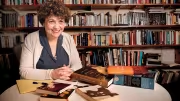
Pardis Sabeti
For this systems biologist, the interaction of science and music is multiplicative.

Pardis Sabeti | Photograph by Olivier Douliery/L'oreal /Abacausa
You might also like
Two Scientists Bring the Laboratory to the Stage
The play Spare Parts is a contemporary fable about the quest to live forever.
A Harvard Choral Group Sings Again, 50 Years Later
The Harvard-Radcliffe Collegium Musicum reunites for a 50th anniversary tour around France.
Cambridge Once Fought Harvard’s DNA Research. Now There’s a Play About It.
A theatrical reenactment explores a 1976 clash between science and democracy.
Most popular

Explore More From Current Issue

The Harvard graduate’s roundtable talk show touches on hot button issues from religion to sex.

In 1954, Gregory Corso moved into Eliot House. How he stayed there is a literary legend.

A roundup of University news from the summer of 2026