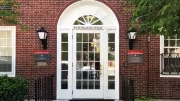
Harvard outlines broad principles for house renewal

Harvard has released a report on the role of the Houses in undergraduate life, in preparation for a major renovation.

Dining halls (such as Eliot's) are "the hub of House life," says a report on the residences, and every House should have its own.

Dining halls (such as Eliot's) are "the hub of House life," says a report on the residences, and every House should have its own. | Rose Lincoln/Harvard News Office

The report said libraries (like this one in Winthrop) are key to House life and should be open 24 hours a day if possible.

The report said libraries (like this one in Winthrop) are key to House life and should be open 24 hours a day if possible. | Rose Lincoln/Harvard News Office

In early April, dean of Harvard College Evelynn M. Hammonds released the results of a year-long review of the residential House system, commissioned as part of the preparations for a major physical renovation of the Houses [see “What Makes (and Remakes) a House,” July-August 2008, page 66]. The Report on Harvard House Renewal includes undergraduate survey results, the findings of focus groups, and the recommendations of the House Program Planning Committee; as Hammonds wrote in an accompanying letter to colleagues, it affirms “that the House system is essential, not ancillary, to a Harvard education as it aims to engage students in the intellectual life of the College and the University beyond the classroom.”

The recommendations run the gamut of House life, ranging from the educational and programmatic to the architectural. Pointing to the importance of the Houses in promoting meaningful faculty-student interaction, for example, the report calls the Senior Common Room system (which affiliates a number of faculty and staff members with each House) “an outdated concept that in many cases is not working well….” Proposed instead is a new House Fellows program, to be tested in a few Houses, in which participants would be appointed to short, renewable terms with clearly defined expectations.

Another aim of the review process was to identify common spaces that could be shared among Houses, such as grilles, event venues, and theaters. Dining halls, deemed “the hub of House life,” were excluded because they serve many purposes, even when not in use for dining. 

There were also many reaffirmations of what the Houses do right and should uphold, including their commitment to individual House libraries, to intergenerational interactions, and to a residential population size of 350 to 500 students. Although the project ultimately aims to eliminate “walkthrough” bedrooms and overflow housing as part of badly needed renovations of the physical structures and their systems, construction planning has not begun. That expensive work—though largely dependent on fundraising in the current fiscal situation—is projected to begin in 2012, and to take 12 years to complete. 

Related topics

You might also like

Six from Harvard Named Rhodes Scholars

Four Americans and two Canadians will begin studies at Oxford next fall.

Judge Dismisses Case Demanding Harvard Admissions Data

The government failed to meet procedural requirements before suing the University.

Harvard Graduate Workers Begin Strike

In the second walkout in six months, union leaders call for better pay and benefits and a stronger grievance process.

Most popular

How Philosophy at Harvard Saved Itself

As humanities shrink across higher education, one department is flourishing. Is its success a fluke, or a roadmap?

Harvard Weathers a Year of Turmoil

The federal government has launched unprecedented actions against the University. Here’s a guide.

Lafayette’s Unexpected Gift to George Washington: Pheasants

The two birds will be on display at Harvard this summer.

Explore More From Current Issue

Collage of book covers featuring various titles on a vibrant orange background.

These newly released novels, histories, and memoirs grapple with identity in all its forms.

A smiling man in a brown plaid suit stands outdoors with greenery in the background.

The professor and former Harvard College dean is the next president of Harvard Magazine’s Board of Directors

Panoramic view of Harvard University with autumn foliage and a river under a cloudy sky.

The University is expanding industry ties and investing its own funds to support research, but neither will replace lost federal dollars.