Where They’ll Work
The Crimson’s senior survey regularly shows the preponderance of graduates who join the workforce opting for jobs in finance, the tech industry, and consulting, no matter the exhortations to public service, teaching, and so on. This year held to form: half of respondents said they are headed to such roles—and overwhelmingly at six-figure starting salaries. The day before Commencement, the New York Times highlighted the phenomenon in a feature titled, “What Do Students at Elite Colleges Really Want?” Drawing heavily on Harvard examples, it documented a Gen Z preoccupation with “‘making a bag’ (slang for a sack of money) as quickly as possible”—in some cases to help needy families, in others out of a sense that “traditional avenues of social change, like government and nonprofits” are feckless, and that wealth joined with future altruism is a more effective, even moral, course forward.
Plus ça Change…
Change naturally resonates as a graduation theme. Given the past half-decade (pandemic, economic crisis, wars, white-hot politics, social media, AI), that seems especially so now. Leave it to the fiftieth reunioners’ class secretaries A’Lelia Bundles and Tom McKinley to supply some perspective—which may induce hope or despair: “When we left Cambridge, the war in Vietnam was winding down and a White House-induced constitutional crisis was looming. As we return, there is war in Ukraine, Israel, Gaza, and elsewhere, and a presidential election that will shape the future of American democracy.”
Community of Discourse?
For the second consecutive year, the Harvard News Office instructions to journalists seeking credentials to cover Commencement advised, “Conducting interviews is not permitted on Harvard property during Commencement activities”—an injunction with which this year’s guest speaker, Nobel Peace Prize-winning journalist Maria A. Ressa, might find it uncomfortable to comply while doing her day job.
Theses Three
The Radcliffe Institute conferred the Fay Prizes for most outstanding theses on three seniors, whose work anecdotally suggests the scope of the College’s academically astounding young scholars’ interests today: Charlotte S. Baker, “Judges, Loved Ones, and Bondsmen: An Ethnography of Cash Bail in a Southern U.S. History,” a work of social science with obvious policy consequences; Dhruv Goel’s mathematically “beautiful” (in his nominator’s word) “The Joys of the Atiyah-Singer Index Theorem”; and Justin Hu’s fusion of cultural history and literary analysis, “Studying with Césaire: Caribbean Counter-Pedagogies of the Lycée Victor Schoelcher during the Third Republic, 1870-1945.”
Harvard Worldwide
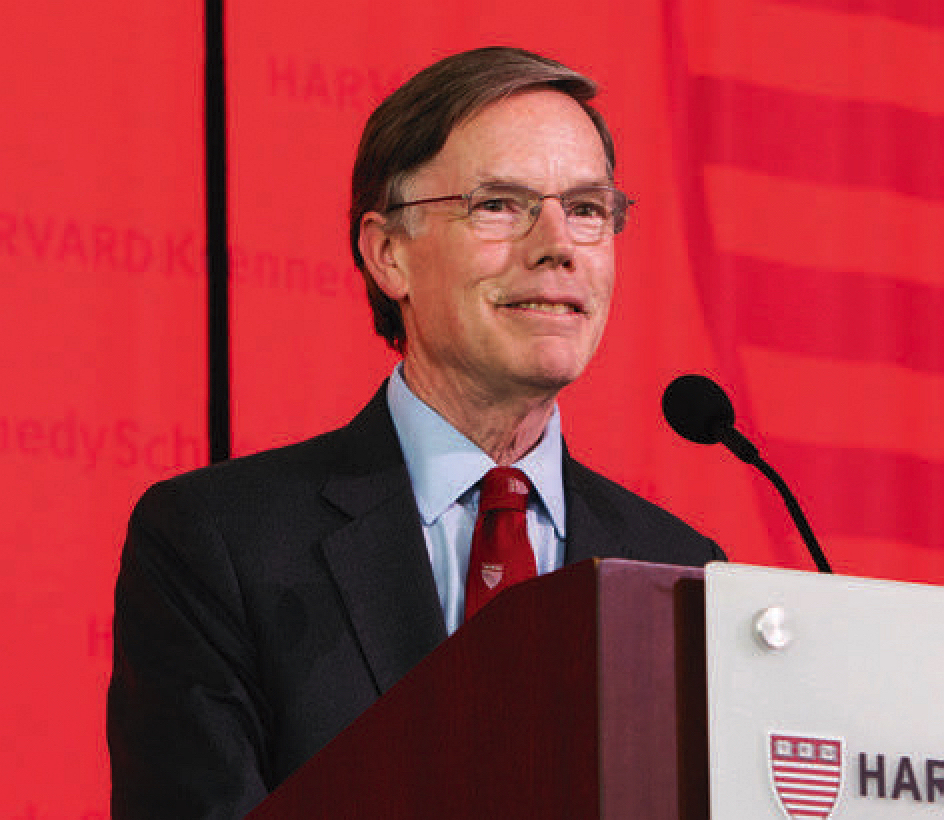
Kennedy School class day speaker Nicholas Burns (formerly on the faculty, now in the “easy, cushy, stress-free job” of U.S. ambassador to the People’s Republic of China) talked about finding alumni everywhere, including “just last month [when] my wife, Libby, and I were at Easter Sunday Mass at Beijing’s North Cathedral. There is a point in the Catholic mass when one turns to the people around you to say ‘Peace be with you.’ I turned to the woman to my left and, before I could speak, she said, ‘Peace be with you, Professor Burns, I was in your ‘Great Powers’ class in 2014’!”
Crimson Complications
Like those in the larger society, campus divisions this year over the Israel-Palestine war are often described in binary terms. But underneath (literally, in this case), the fractures can be far more complex. Gathering in Sever Quad for the procession into Tercentenary Theatre, several Divinity School candidates wearing angel wings had mortarboards with signs demanding “Human Dignity for Everyone No Exceptions.” A classmate, with a keffiyeh draped around their shoulders, struggled with the mortarboard (“Harvard Funds Genocide”); it slipped off, revealing a yarmulke underneath.
Green Gang
Alongside the return of robins and turkeys, the arrival of crews from F&L Landscaping Corporation, of Braintree, Massachusetts, signals the advent of spring on campus. Their annual tilling and hydroseeding of Harvard Yard’s winter-worn turf (see the video on the company website) sets the stage for Commencement revelers to pound it into bare earth again some weeks later. The surest sign that the 373rd festival rites would proceed where scheduled was the F&Lers’ appearance early on May 15, busily restoring the sward between Massachusetts and University Halls, where protestors had tented until the day before. A trailer load of sod delivered May 17 was promptly emplaced—perhaps to survive through Alumni Day.