
Have you an urgent need to know the number of genito-urinary disorders in horses that doctors treated at the Free Clinic of Harvard's Veterinary School in April 1899? The Harvard-Radcliffe Online Historical Reference Shelf will answer your question.
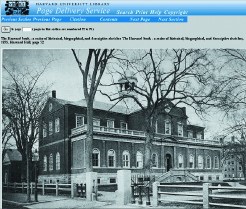 At https://hul.harvard.edu/huarc/refshelf/HROHRSHome.htm you will find annual reports of the presidents and treasurers of Harvard and Radcliffe from 1825 to the present, narrative histories of the University, the Harvard Fact Book from 1997 to the present, and founding documents concerning Harvard from 1642 to 1814.
The Reference Shelf is a joint project of the Harvard University Archives and the Radcliffe Archives and is supported by the Harvard University Library Digital Initiative. It is a work in progress, an ever-more-important resource.
The library so far has scanned more than 105,000 pages of text, and the resulting digital images have been sent to an outside vendor for full-text conversion using optical character recognition software. Those pages may be viewed on-line as pages, with their original look, and searched as well.
The direct costs of scanning and so forth have been about $40,000 to date, but the primary cost of the project lies in the salaries and other on-going overhead costs involved in running the systems that support it, says Robin McElheny, associate archivist for programs in the University Archives.
A search of the presidents' reports for "veterinary school 1899" will lead you to the information you want about horses, which is "One." The clinic had 443 patients in all that month, mostly horses, cats, and dogs, but a cow with indigestion came in, a rabbit who needed an operation, and two squirrels, one with respiratory trouble, the other with an abscess in the throat. All these recovered.
But alas, the school itself was ailing. It had 20 students in the fall of 1900, one reads, but no endowment, and it was losing money. The Corporation judged that the school could not be sustained. What to do with the students? In 1901 the University offered to pay their tuition to the veterinary department of the University of Pennsylvania, and all but three went there the following year. "The School was permanently closed," wrote Dean Charles P. Lyman, "after a not uneventful or unworthy career of nineteen years."
The reports of the presidents tell of the growth of faculties, as well as their demise, of the expansion and alteration of curricula, and of the mood of the times. One sees, for example, how President Nathan M. Pusey characterized the academic year 1968-69 ("...a dismal year").
Among narrative histories included in the Online Historical Reference Shelf is the 800-page, two-volume information gold mine, The Harvard Book, first compiled by Frederick O. Vaille and Henry Alden Clark in 1875. It offers an illustrated, comprehensive history of campus life up to that time, including Harvard's customs, buildings, organizations, and notable faculty members and alumni.
Robin McElheny looks forward to putting course catalogs old and new on-line. One could then easily discover when Harvard first taught experimental physics, or that in 1938 Radcliffe offered a senior elective on marriage. She would like to see on-line an historical catalog of all graduates of Harvard and Radcliffe. She can even imagine scanning early issues of this magazine, sometimes said to be a good source of information about Harvard. Making the pages searchable would mean that a researcher need not come to the magazine's offices during working hours to consult the dog-eared three-by-five-inch index cards in the file cabinets in the second-floor hallway.
McElheny welcomes suggestions of reference material to include on-line. She may be reached at robin_mcelheny@harvard.edu.





