 |
| Residents bordering Harvard have turned building projects into political battlegrounds. Below, a Harvard rejoinder. |
 |
More than five years of discussions and negotiations between Harvard and neighbors about the University's proposed Center for Government and International Studies (CGIS) have yet to yield compromise. Harvard initially recast the proposed center as two buildings, not one, after complaints about the loss of open space behind the Graduate School of Design. That redesign called for a tunnel under a public street, in order to connect the two buildings. When neighbors objected to the scale and massing of the second proposal, Harvard redesigned the buildings again, made them smaller, and put even more space below grade. But local residents, cognizant of the mayhem caused by Cambridge's recent sewer-separation project, are objecting to the construction impacts of a tunnel. In its latest bid for community support, Harvard offered to donate nearby land as a small park, contribute $300,000 to neighborhood improvement funds, and accept a variety of construction and use restrictions extending as far as 2015. An agreement reached on July 3 subsequently unraveled. Harvard now plans, if necessary, to proceed without the tunnel (which would have allowed consolidation of five area loading docks). Demolition of Coolidge Hall (future site of the north building, and recently vacated by faculty and staff) is slated to begin in the fall.
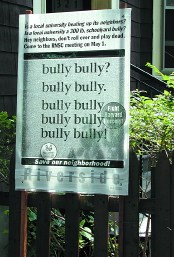
A similar scenario is playing out on the Charles River at Western Avenue, where Harvard proposed to put an art museum. That, too, would require an easement from the city for construction under a public way. Citing lack of community support, Harvard withdrew the museum proposal and now plans to erect graduate-student housing. Residents oppose that, too. Some members of the local Riverside Study Committee want the city to take the property, which Harvard has owned for more than 75 years, by eminent domain. Officially, they propose a spot rezoning that Harvard considers inconsistent with the "size and character of surrounding structures" like the power plant across the street, which Harvard has agreed to buy and run.