
The Busch-Reisinger museum will celebrate its hundredth birthday by mounting an exhibition, from October 24 through February 15, 2004, devoted to art in Germany in 1903, its natal year. That was a vibrant time in the arts community, as about 40 paintings, sculpture, drawings, prints, and photographs will show.
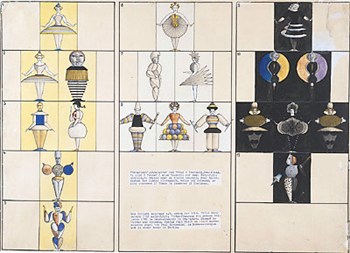 |
| Costume Designs for the "Triadic Ballet" (detail), 1926, by Oskar Schlemmer |
| Busch-Reisinger Museum/Harvard University Art Museums, Museum Purchase/Copyright©2003 President & Fellows of Harvard College |
Giving a gift to art lovers unable to come to the party, the Busch-Reisinger is now presenting an Internet-only, mixed-media, interactive exhibition, "Extra Ordinary Every Day." About Germany's Bauhaus school of art, it concerns the intersection of fine art and the production of useful things and focuses on a lamp, a chair, a house, a theater stage, and an automobile. (It may be seen at www.artmusems.harvard.edu/sites/eoed through December 2005.)
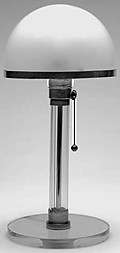 |
| Table Lamp: Base and Lampshade, 1924, by Wilhelm Wagenfeld |
| Busch-Reisinger Museum / Harvard University Art Museums, Gift of Walter Gropius / Copyright©2003 President & Fellows of Harvard College |
The virtues of a virtual exhibition are several. Viewers may experience it at 3 a.m. if they wish, and free of charge. Curators do not have to contend with limited gallery space or, indeed, the limitations of exhibiting in galleries. If objects are of diverse materials, as here, placing them in a gallery creates divisions among them based on that diversity, or perhaps on the fragility of particular items; in virtual space, they coexist in equality. Moreover, as Marjorie B. Cohn, acting director of the Harvard University Art Museums, points out, objects may be kept "on view" in cyberspace "far longer than the artworks themselves, some in light-sensitive media, would allow." The exhibition includes a sculpture by László Moholy-Nagy, operated by an electric motor, which he described as "an apparatus for the demonstration of special lighting and motion effects," and a short film by him, Lightplay: Black, White, Gray. Says Cohn, "The Moholy-Nagy film and sculpture, which is very fragile and cannot be operated without risk, can now be set into virtual motion on demand."
The exhibition includes 21 objects from the museum's permanent collection but is augmented by links to other works by these artists in the art museums' database.
The Bauhaus show was organized by former Werner and Maren Otto curatorial intern Kimberly Mims, the birthday exhibition by current intern Adrian Sudhalter. The Busch-Reisinger is the only museum in the United States devoted to collecting, studying, and presenting the art of German-speaking countries and, in a rare circumstance among U.S. art museums, a European group of patrons supports it. Verein der Freunde des Busch-Reisinger Müseums numbers more than 240 members, in Germany as well as Austria, Switzerland, and other countries. The Friends make possible many of the museum's programs, including the 22-month curatorial interships: the museum awards one each year, alternating between European and other nationals. The internships provide young people a wide-ranging, hands-on experience, working with senior scholars, to prepare for professional and scholarly careers in art history.





