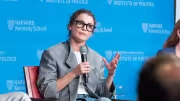
| | Louis Menand | | Photograph by Stu Rosner |
|
Though readers of the New Yorker might identify him as a gifted book critic and stylish essayisthis pieces are 2004 National Magazine Award finalists in both categoriesprofessor of English and American literature and language Louis Menand considers himself an "intellectual historian. I'm interested in where ideas come from, and the influence of one writer on another." His book The Metaphysical Club absorbed 10 years ("It was fun," he says), and won the 2002 Pulitzer Prize for history. It shows how Oliver Wendell Holmes Jr., William James, Charles Sanders Peirce, and John Dewey launched pragmatism and moved "American thought into the modern world." Menand does "a version of American studies," he says. "But nothing before the nineteenth century." Known as "Luke" since childhood (his eponymous father taught political science at MIT), Menand earned a degree in creative writing from Pomona College in 1973, then spent one year at Harvard Law School. "I didn't have the personality to be a lawyer," he says. "I don't like to argue." Instead, he earned a Ph.D. in English from Columbia, then taught at Princeton and CUNY before coming to Harvard last fall. Menand teaches courses on the Jameses (Henry, William, and Alice), and on the art and thought of the Cold War period from 1945 to 1965, the subject of his next book. With his wife, Emily, and two adolescent sons in Manhattan, he commutes between there and Beacon Hill. Menand's elegant prose doesn't emerge from revision: "I don't write drafts," he explains. "My habit is to write one draft, very deliberately." Will there someday be a novel, a screenplay? "Ha!" he says. "I wish."