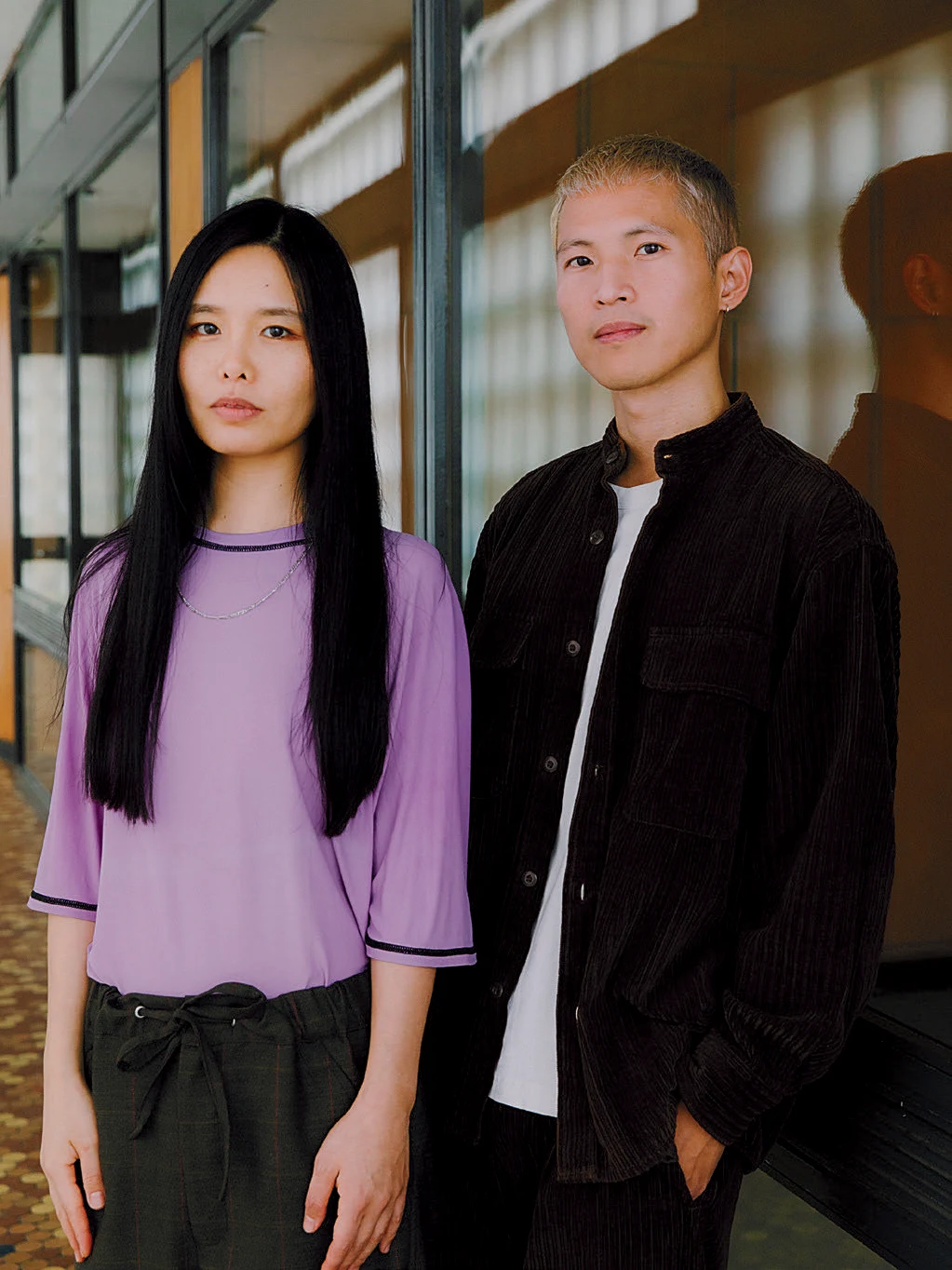
In late 2019, Enzo Camacho ’07 and Ami Lien ’09 arrived in Marseille, France, to begin research for a new work of art. The pair, who have collaborated since they were undergraduates, had been invited to create a piece for the Manifesta 13 biennale, a European cultural and arts event, which was set to take place in Marseille the following year. They spent two weeks in the city gathering ideas. They visited a Buddhist temple run by a Vietnamese monk and made friends with a sushi chef who planned to work with local fishermen to track sea pollution. They met with artists and activists working on labor and environmental issues.
In the end, what stuck with them was an image they’d encountered on their very first day: a monumental stone sculpture at the bottom of the grand staircase leading to the city’s main train station. Installed in 1925 and titled Les Colonies d’Asie (The Colonies of Asia), it depicts a topless, bejeweled woman reclining in a Khmer-style crown and a geisha-style bun—“this fantasy hybrid,” Lien says, “of an Asian woman.” Her hand rests on the head of a Khmer lion, and a basket of fruit, the spoils of conquest, overflows at her feet.
“That monument left such an imprint on our minds,” says Camacho, whose work with Lien—incorporating sculpture, video, painting, and handmade paperworks—often explores the colonial histories of Asian countries and how past events in the region continue to shape contemporary life. “We knew we wanted to use that form, and we wanted to convert it.”
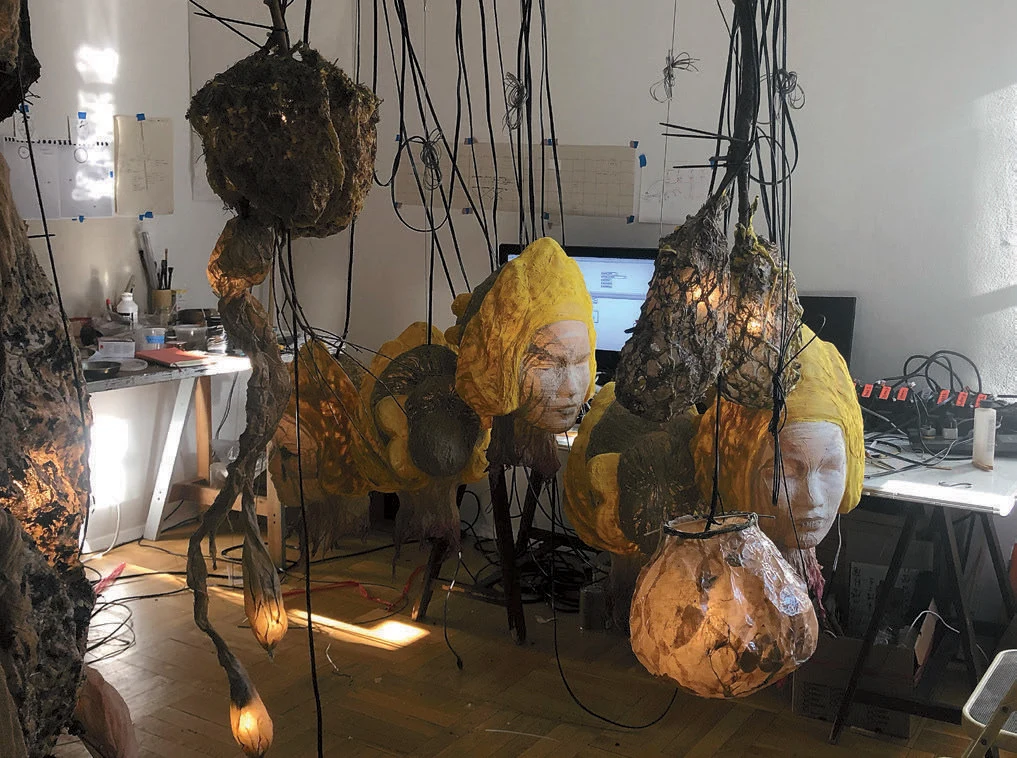
The piece they created for the biennale, Waves Move Bile—currently on display at Harvard’s Carpenter Center for the Visual Arts—reimagines the woman from the monument as an ahp, a folkloric spirit from Cambodia whose body comes apart at night as she floats through the air, a glowing head dangling her organs behind her. “This is a mythological figure that exists in different forms all around Southeast Asia,” Camacho says, including the countries that, like Cambodia, were once part of French Indochina. In the Philippines, where he grew up, the folkloric figure was known as a manananggal, a terrifying winged monster whose head and upper torso would roam at night, leaving her legs behind.
The artwork consists of five sculptures suspended from the ceiling, each with a head modeled on the Marseille monument, trailed by a heart, lungs, intestines, and other viscera. Soft light illuminates the sculptures from within, like lanterns—or ghosts. “The idea was about decapitating this monument, this allegory of colonialism,” says Camacho, “but also trying to give it new life, a different kind of resonance. To turn it inside out.”
“To take it back,” Lien says.
They built the artwork in the early months of 2020, under constraints imposed by the COVID-19 pandemic. To make the paper-like material that forms the sculptures, the artists gleaned plant fibers from kitchen scraps and grass they harvested from parks near their homes. Lien made one of the artwork’s hearts out of kombucha skins. “Everybody was brewing their own kombucha during the pandemic,” she says. “I made a giant scoby in a tub and then molded it.”
Normally, Camacho and Lien, who create projects together in countries all over the world, draw their materials from local sites, to “situate” the artwork, Camacho says, in the social and political issues they’re addressing. With Waves Move Bile, that rootedness was harder to achieve, but they still found ways. “We were pulping lemon peels and orange peels,” Lien says, to replicate the gold of the Khmer crown. Experimenting with dyeing techniques, she discovered that turmeric produced a brilliant orange.
In Southeast Asian culture, the ahp and similar figures have been associated with otherness and fear, sometimes depicted as cursed by black magic or dangerous to pregnant women. But Camacho and Lien saw other meanings in the ahp’s mangled body: survival, resilience, the possibility of renewal after the fracture of colonialism and war. Lien also points out that in the region’s traditional animistic belief systems, “where you’re negotiating with these non-human, otherworldly beings,” figures like the ahp “were not all terrible.” In fact, she says, some theories contend that they became increasingly demonized with the spread of Catholicism.
At the Carpenter Center, Waves Move Bile is part of Knowledge Is Myth: Chimeric Continuities, an exhibition on view through December 13, featuring works from Asian diasporic artists that curator Danni Shen says “complicate the binaries” of subjective and objective ways of understanding the world. One of the show’s other artists, Candice Lin, creates fantastical collages mimicking the pages of a scientific archive to question how knowledge is produced and consumed. Another series of works explores eco-spiritual rituals from pre-colonial Korea, contrasting them with images of ecological rupture in the demilitarized zone between present-day North Korea and South Korea.
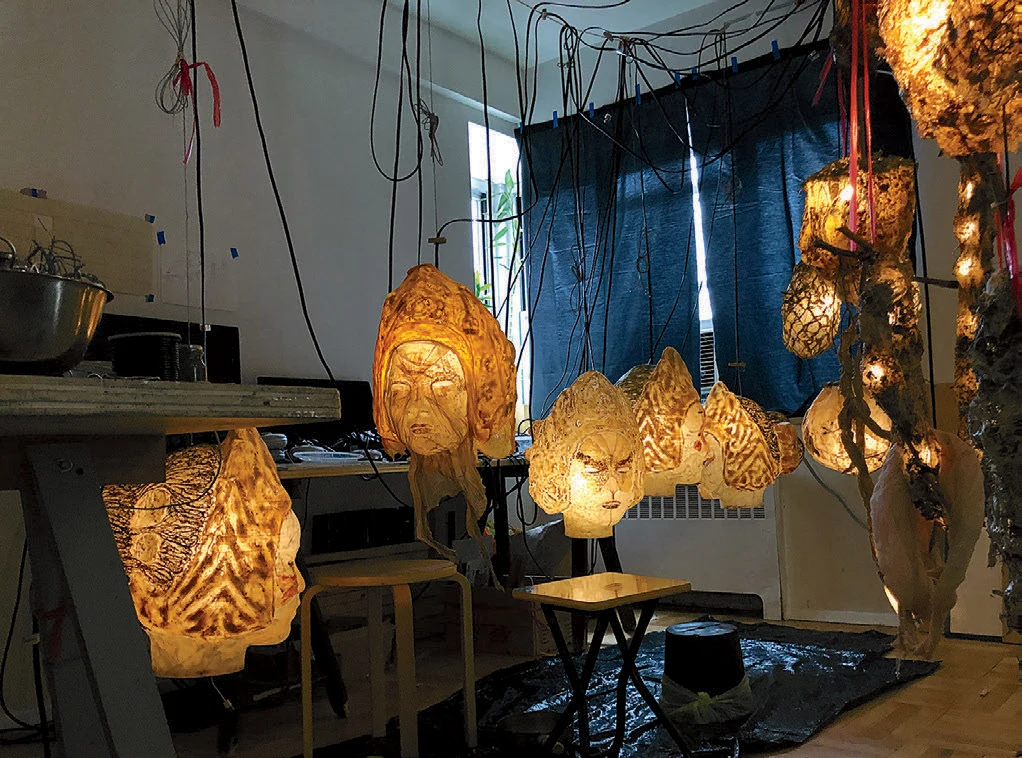
Waves Move Bile is the show’s most technically complex work. Its lights flicker in syncopated pulses, timed to an audio track of ambient and bodily sounds—running water, ticking clocks, church bells, hiccups, coughs, footsteps, and even the trickling splash of someone peeing. The most intimate of those sounds are informed partly by traditional Chinese medicine (which also influenced the artwork’s title); that practice was always in the background of her family’s culture, says Lien, who grew up mostly in Arizona as the child of Taiwanese immigrants. She and Camacho also organized the sculptures’ structure according to the traditional Chinese medicine concept of the body’s five core organ systems: heart, liver, spleen, lung, and kidney.
Partly, though, the artwork reflects the time in which it was produced—when the pandemic halted activity around the globe soon after their trip to Marseille, the two artists found themselves in lockdown an ocean apart. Camacho is based in Berlin and Lien in New York City; typically, they come together during months-long residencies in places like Singapore, Shanghai, Cambodia, and the Philippines. Some of their most important artwork evolved from trips to the Philippine sugar plantation island of Negros, where they first traveled in 2017 to study a 1950 mural in a workers’ chapel. Known as The Angry Christ, it was painted by abstract expressionist Alfonso Ossorio ’38. Coinciding with the Carpenter Center’s exhibit, the Harvard Art Museums is holding a show of his work, Alfonso Ossorio: Line and Lineage, open through April 11, 2027.
In 2020, Lien and Camacho were sending messages and recordings back and forth (the coughs and other bodily sounds are theirs), while separately constructing pieces of the sculptures. The resulting artwork is haunting, both beautiful and grotesque. Its sense of physical dislocation fits the circumstances of its creation. “It was important to us to present the figure of the ahp as an open wound,” Camacho says, “to visualize the aftermath of colonialism as a continuing struggle, a thing that people are still trying to survive and fight at the same time.”