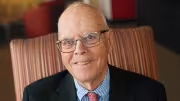
En route to the math placement exam, Annette Ghee ’83 met classmate Burt Hamner. Each one thought the other cute… and they were engaged before graduation. That day in 1979 was not the last time they found human connections amid math and science. Today Hamner runs a start-up he founded to explore generating power from tidal currents. Ghee focuses on treating sexually transmitted diseases in the Third World; she completed a Ph.D. in epidemiology at the University of Washington (UW) a year ago and most recently spent six weeks in Mozambique as “data wrangler” for a UW colleague’s AIDS project. The couple’s environmental and global health work has spanned 35-plus countries and more than 20 years, and neither spouse feels like slowing down.
Hamner’s marine-biologist parents gave him an early interest in their field, though at Harvard he studied history of science after deciding that “people are more interesting than animals.” He became an environmental coordinator in Seattle for the Army Corps of Engineers; as he studied possible solutions to the area’s polluted sediment, he became an expert on Puget Sound’s scientists and bureaucrats as well as its shoreline and currents. He earned an M.B.A. and a master’s in marine affairs from UW, learned about the commercial side of marine science as marketing director for a fisheries hydroacoustics company, and advised businesses for the state’s Department of Ecology.
Meanwhile Ghee, after working in arts management, was inspired by a friend to shift to public health. Growing up on Manhattan’s Lower East Side, she became aware of prostitution, violence, and homelessness early and says such “visceral” situations did not make her squeamish: “I knew my perceptions of those realities were sharp and could be put to good use.” She earned an M.P.H. from UCLA in 1990, specializing in health promotion, communication, and education, and became manager of the Center for AIDS & STD, a Seattle-based global-health program.
The couple varied not only their job descriptions, but also their locations. “We decided we wanted international careers, and planned for it,” Burt explains. In 1996 he joined the U.S. Agency for International Development to lead seminars on clean production for Southeast Asian companies. Ghee was then running a UW initiative in Manila, so they moved there with their five-year-old, Lea. (Ghee says showing their daughter the world beyond the United States was “one of the best things we’ve done as parents.”) On another stint, in Lima, Hamner taught at the Universidad del Pacífico, and Ghee collaborated for 13 months with Peruvian physicians to set up a reproductive health clinic to serve and study local sex workers. Sometimes, one or both worked overseas even when they lived stateside: Hamner commuted to work for Thailand’s Ministry of Science, Technology and Environment every other month for two years.
Sadly, he realized that in Third World countries, “The practical fact is that economic growth is overwhelming all efforts to mitigate climate change.” His new goal is to mitigate climate change in the most economically developed nation on Earth, starting where his environmental career began. In 2006 he founded a consulting group, Puget Sound Tidal Power; the company is now conducting what Hamner admits is a “complex” feasibility study of commercial-scale tidal-energy production that involves “eight firms and three professors covering physical oceanography, estuarine current modeling, bathymetric and geotech survey, environmental issues, shoreline management, federal-state-local permitting, economics, and technology analysis.” But his primary endeavor is Tidal Energy Systems (TES), which designs and manufactures turbines that can harness tides, waves, and river currents. (TES’s co-founder is classmate and friend Chris Leyerle, who “loves details and administration” with which he, Hamner says, sometimes struggles.)
Such projects could keep Hamner in Seattle for years, but he stays alert to opportunities abroad. “India and Mozambique,” he says, “have big rivers and coastal waves that can make renewable power, and public-health problems that Annette likes to work on.” Ghee is ready. “Burt’s and my relationship,” she says, “has always included a shared joy of adventure.”
~Joseph P. Shivers