Cartographic deltiologists will make beelines now to the Harvard Map Collection in Pusey Library: it has recently become home to more than 10,000 map postcards. Here’s a card showing a baby hoisting a barbell of oranges and standing on a map of Florida; another card bearing “Greetings from the Ohio Turnpike”; a Cape Cod postcard in the shape of a codfish; a British card with train, ship, and route-of-passage map promoting the India Mail (8,000 bags of mail dispatched each Thursday); and a valuable Hungarian card with movable parts showing that country before World War I and how it looked after big pieces of its territory were awarded by the Treaty of Trianon to four adjacent countries.
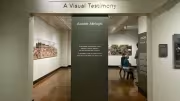
The library’s exhibition Communicating with Geography: The Siegfried Feller Collection of Map Postcards sampled a vast range of cards earlier this year; more will appear on-line in future. Donor Feller is a librarian, retired from the University of Massachusetts Amherst, and published the now discontinued newsletter Cartomania.
The history of the postcard is said to have begun in Philadelphia in 1861 when John P. Charlton patented and H.L. Lipman published a card with a blank front for writing necessarily short messages; the impossibility of letter-length communication was a selling point. Illustrated government postal cards and privately printed souvenir cards with scenes from the Columbian Exposition were a landmark hit in 1893 and contributed further to the death of letter-writing. By law, one still could not put messages on the address side of cards, and the scant empty space on the front next to the il-lustration permitted only the pithiest effort, as in “Hello, Ethel,” or “Wish you were here.”
The golden age of postcards in the United States began in 1907, when changing regulations permitted both the address and the message to be on the back of the card, giving over the entire front to images of bathing beauties on Old Orchard Beach, Maine, and countless other wondrous sights immediately popular with travelers and collectors.
Since Harvard became keeper of what is perhaps one of the three largest collections of postcards in the world, David Cobb, curator of maps, has shouldered new deltiological responsibilities. He says he regularly finds himself on eBay trying to fill gaps in the collection.