In 1937, John Singer Sargent’s sister, Violet, donated a truckload of material from the late artist’s estate to Harvard. The haul contained studio tools, such as easels and brushes, as well as original sketches and paintings —including Still Life: Daffodils, an oil study on canvas that arrived unframed, rolled up, and water-damaged.
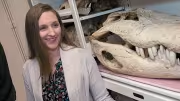
It’s common for museums to receive items in such condition. “A lot of things in vast collections are ‘fragile but stable’—they’re not going to spontaneously combust, but they cannot be shown to the public,” explains Saffie Patel, a Shader fellow in paintings conservation who completed her two-year posting at Harvard Art Museums in June. “A tiny portion of Harvard’s artworks are actually on the walls,” she says.
Recently, Harvard Art Museums curators decided that Daffodils should be among them. The painting, which shows flowers in a silver cup beside two wine glasses on a white tablecloth, went on display this spring for the first time in its history. It’s a rare still life from Sargent, best known for his portraits and masterful brushwork; as a study, it offers a glimpse of his style freed from editing or revision.
“John Singer Sargent’s modus operandi was creating artworks that felt like they’d been carried off in a single pass, but in real life took a lot of reworking,” Patel says. “This was actually done in one go. You get this spontaneous look at the hand of the artist.”
Getting the painting ready for the public took an ambitious restoration that spanned the fellowships of Patel and her predecessor, Lauren Cox. Cox took care of the initial salvage work, gluing tiny pieces of the chipping paint back to its canvas and carefully cleaning off dust and mold.
After that, Patel worked on getting Daffodils safely stretched, flattened, and framed after nearly a century of being rolled up. She used a method from her restoration training in the Netherlands, employing a vacuum seal, weaving inserts into the canvas, and alternating cycles of heat and pressure to ease out creases. She did color and texture matching on some of the more obvious spots of damage, a painstaking process requiring impossibly small brushes (“three or four hairs,” Patel says).
The freshened-up Daffodils will be on display for the foreseeable future. But in keeping with the ethics of conservation science, many elements of Cox and Patel’s work are reversible, in case more effective methods are developed one day.
“The materials we use can all be removed without damaging the original,” Patel says, “and we can return it back to its crumbly, unstretched state if we really need to.”