Campaigning by Text Message

The cell phone—and, more specifically, the text message—is the next frontier for political campaigning and communication, Garrett M. Graff ’03, a former Ledecky Undergraduate...

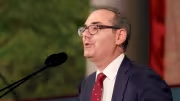
The cell phone—and, more specifically, the text message—is the next frontier for political campaigning and communication, Garrett M. Graff ’03, a former Ledecky Undergraduate Fellow at Harvard Magazine, wrote in a New York Times op-ed last week.

The Obama campaign's promise to announce a vice-presidential choice first via text message means those who submit their mobile numbers will be the first to know. It also means the campaign will have their mobile numbers for other purposes, such as sending a reminder to vote on election day.

Graff, an editor at Washingtonian magazine and former Webmaster for Howard Dean, is the author of The First Campaign: Globalization, the Web, and the Race for the White House. He goes beyond the simple observation that as landlines fall out of favor, text messages are the way of the future, to offer some modern technological history: the medium has already been used to galvanize support for political movements in the Philippines, Spain, and Myanmar.

After reading the op-ed, you can hear Graff discuss the same topic in a podcast.
Related topics

You might also like

A new book explores the Harvard-trained architect’s vision and impact, from Ground Zero to the Smithsonian.

The play Spare Parts is a contemporary fable about the quest to live forever.

David Battat promotes alumni engagement.

Most popular

Harvard Weathers a Year of Turmoil

The federal government has launched unprecedented actions against the University. Here’s a guide.

Lafayette’s Unexpected Gift to George Washington: Pheasants

The two birds will be on display at Harvard this summer.

Harvard’s Class of 2029 Reflects Shifts in Racial Makeup After Affirmative Action Ends

International students continue to enroll amid political uncertainty; mandatory SATs lead to a drop in applications.

Explore More From Current Issue

Caricature of a young man in front of red doors, wearing a green striped sweater.

In 1954, Gregory Corso moved into Eliot House. How he stayed there is a literary legend.

Three actors perform on stage, with one actor interacting closely with another, set against abstract backgrounds.

The play Spare Parts is a contemporary fable about the quest to live forever.

Three hands hold smartphones displaying social media profiles with likes and hearts.

Tell us about how social media impacts your daily life.