Harvard art exhibit "Tangible Things"

An exhibition asks the meaning of things.

Vase and Palette by Katya Kallsen, © President and Fellows of Harvard College; Plow, © President and Fellows of Harvard College

Vase and Palette by Katya Kallsen, © President and Fellows of Harvard College; Plow, © President and Fellows of Harvard College

<i>Blolo Bla (Spirit Partner),</i> Baule, 19th–20th century.

Blolo Bla (Spirit Partner), Baule, 19th–20th century. | Harvard Art Museums/Fogg Museum, The Lois Orswell Collection, 1998.311. Photo: Junius Beebe © President and Fellows of Harvard College.

Edward Lamson Henry, <i>The Message,</i> 1893. Oil on board.

Edward Lamson Henry, The Message, 1893. Oil on board. | Harvard Art Museums/Fogg Museum, Anonymous Gift, 2003.279. Photo: Katya Kallsen © President and Fellows of Harvard College.

Hughes-type Printing Telegraph, Louis-Clément Breguet, c. 1875,

Hughes-type Printing Telegraph, Louis-Clément Breguet, c. 1875, | Collection of Historical Scientific Instruments/Harvard University

John Parker and Edward Wakeline, Silver Teapot. [ca. 1765]

John Parker and Edward Wakeline, Silver Teapot. [ca. 1765] | Houghton Library/Harvard College Library/© President and Fellows of Harvard College

Manner of Douris, <i>Red-Figure Lekythos: Woman Holding an Alabastron,</i> Greek, 480–470 BC.

Manner of Douris, Red-Figure Lekythos: Woman Holding an Alabastron, Greek, 480–470 BC. | Harvard Art Museums/Arthur M. Sackler Museum, Gift of Frederick M. Watkins, 1959.193. Photo: Junius Beebe © President and Fellows of Harvard College.

Myer Myers, <i>Cann,</i> 1750–60. Silver.

Myer Myers, Cann, 1750–60. Silver. | Harvard Art Museums/Fogg Museum, Bequest of David Berg, 1999.306.1. Photo: Junius Beebe © President and Fellows of Harvard College.

Jean-Baptiste Oudry, <i>Standing Bird</i> from the <i>Avian Album,</i> 18th century. Watercolor and black ink over traces of graphite on off-white antique laid paper, adhered to cream antique laid paper.

Jean-Baptiste Oudry, Standing Bird from the Avian Album, 18th century. Watercolor and black ink over traces of graphite on off-white antique laid paper, adhered to cream antique laid paper. | Harvard Art Museums/Fogg Museum, Anonymous Gift, 1953.75.11. Photo: Allan Macintyre © President and Fellows of Harvard College.

Jean-Baptiste Oudry, <i>Two Peacocks</i> from the <i>Avian Album,</i> 18th century. Watercolor and black ink over traces of graphite on off-white antique laid paper, adhered to cream antique laid paper.

Jean-Baptiste Oudry, Two Peacocks from the Avian Album, 18th century. Watercolor and black ink over traces of graphite on off-white antique laid paper, adhered to cream antique laid paper. | Harvard Art Museums/Fogg Museum, Anonymous Gift, 1953.75.13. Photo: Allan Macintyre © President and Fellows of Harvard College.

Hiram Powers, <i>Loulie's Hand,</i> 1839–77. Marble.

Hiram Powers, Loulie's Hand, 1839–77. Marble. | Harvard Art Museums/Fogg Museum, Gift of Professor James Hardy Ropes, 1928.115. Photo: Katya Kallsen © President and Fellows of Harvard College.

[extra:Extra]

In the gallery below, see extra images beyond what appeared in print.

Imagine you are curator-in-chief of all of Harvard’s collections of tangible things and a donor gives you a 114-year-old Mexican tortilla. Where in your almost 50 collections do you put it?

Tangible Things, an exhibition on view through May 29, principally at galleries of the Historical Scientific Instruments Collection in the Science Center, brings together roughly 200 intriguing things--art works, specimens, tools--from troves throughout the University. Around the periphery of the galleries, write the exhibition organizers, “are objects displayed according to categories used at Harvard and elsewhere since the nineteenth century, categories that were instrumental in creating the disciplinary boundaries that still define many of our undergraduate concentrations and that still structure many of the world’s museums.” In the middle of the space is an array of seemingly inscrutable objects. Viewers are challenged to decide in what collections to place them--and why. What about that tortilla?

To further their points about categories and meanings, exhibition organizers have taken things from their usual locations--including the three shown on this page--and placed them as “guest objects” in seven other museums at Harvard, inviting viewers to go on a scavenger hunt to find them. A palette used by painter John Singer Sargent (1856-1925) is normally housed at the Harvard Art Museums, with paintings by the master. In Tangible Things, it is at the Science Center, shown as a tool along with items related to color and the brain.

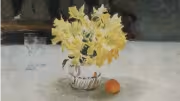
The floriform vase made by Louis Comfort Tiffany around 1900 is also usually at the Art Museums, but is for the moment a guest at the Harvard Museum of Natural History, where it sits among the celebrated glass flowers made by the Blaschkas, father and son. Visitors may wonder about the line drawn between art and science. Why were the Blaschkas’ flowers considered scientific tools, while Tiffany’s were art?

The walking plow, probably Massachusetts-made in the late eighteenth century, from Harvard’s General Artemas Ward House Museum in Shrewsbury, Massachusetts, is saved there because of its associations with the Revolutionary War general, A.B. 1748. It is now a guest at the Semitic Museum, near an Iron Age plow of similar design.

The exhibition is the work of 300th Anniversary University Professor Laurel Thatcher Ulrich; senior lecturer Ivan Gaskell; Wheatland curator of the Collection of Historical Scientific Instruments Sara Schechner; and lecturer Sarah Anne Carter. (Ulrich and Gaskell are teaching a new General Education course with the same title.) They found their tortilla in the Economic Botany Herbarium of Oakes Ames.

Read more articles by Christopher Reed

You might also like

The Gretel and the Great War author on how the Lampoon derailed his science career—and set him on a literary path.

Chloe Chapin trains her Broadway costume designer’s eye on the history of men’s fashion.

Harvard Art Museums restores a rare glimpse of an American master.

Most popular

Harvard’s Class of 2029 Reflects Shifts in Racial Makeup After Affirmative Action Ends

International students continue to enroll amid political uncertainty; mandatory SATs lead to a drop in applications.

The Harvard graduate’s roundtable talk show touches on hot button issues from religion to sex. 

In 1954, Gregory Corso moved into Eliot House. How he stayed there is a literary legend.

Explore More From Current Issue

A glowing bulb shape surrounded by colorful, swirling energy lines against a blue background.

Harvard researchers achieve medical breakthroughs in cancer therapy and infection control.

A smiling elderly man in glasses sits comfortably in a striped armchair.

Plus, veteran higher education leader Thomas Ehrlich reflects on university curricula for his 70th reunion

Three hands hold smartphones displaying social media profiles with likes and hearts.

Tell us about how social media impacts your daily life.