Stephen Greenblatt and other Harvardians are finalists for National Book Awards

The Cogan University Professor's recent book, and works by other Harvard authors, reach the finals of the prestigious competition.

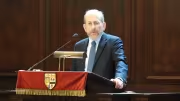
The Swerve, by Cogan University Professor Stephen Greenblatt, is among the five finalists in the nonfiction category for a National Book Award.  The book, described in Harvard Magazine's Right Now section, focuses on the poem De Rerum Natura ("On the Nature of Things")written by the Roman Lucretius more than two millennia ago. The work's allegedly subversive qualities kept it buried from view for almost a thousand years, but its poetic beauty helped it survive and eventually re-emerge. Greenblatt tells how this happened and argues that the long poem has exercised an important influence on modern thought. As his own scholarship has most often targeted Shakespeare and the Renaissance, the new volume is, in a way, a swerve in Greenblatt's own career. 

Greenblatt will give a talk sponsored by the Mahindra Humanities Center, at Harvard's Barker Center, on October 26. The speech, titled "Aesthetic Toleration: Lucretius and the Survival of Unacceptable Ideas," begins at 6 p.m.

Other National Book Awards finalists with Harvard connections include:

  • poet Adrienne Rich ’51, Litt.D. ’90, for Tonight No Poetry Will Serve: Poems 2007-2010;
  • fiction writer Edith Pearlman ’57, for her short-story collection Binocular Vision;
  • poet Carl Phillips ’81 (who reads his 2008 Phi Beta Kappa poem here), for his book Double Shadow. 

In addition, poet John Ashbery ’49, Litt.D. ’01,  will receive the 2011 Medal for Distinguished Contribution to American Letters at the November 16 National Book Awards ceremony, which will be hosted by actor and author John Lithgow ’67, Ar.D. ’05.
You might also like

The University has pushed the adoption of AI into teaching and operations, but faculty resistance is growing louder.

The division is launching a new fundraising effort to support 50 additional students.

President Alan M. Garber used traditional Memorial Church address to consider the unique qualities of human intelligence and learning.

Most popular

Harvard’s Class of 2029 Reflects Shifts in Racial Makeup After Affirmative Action Ends

International students continue to enroll amid political uncertainty; mandatory SATs lead to a drop in applications.

Harvard Weathers a Year of Turmoil

The federal government has launched unprecedented actions against the University. Here’s a guide.

Lafayette’s Unexpected Gift to George Washington: Pheasants

The two birds will be on display at Harvard this summer.

Explore More From Current Issue

A glowing bulb shape surrounded by colorful, swirling energy lines against a blue background.

Harvard researchers achieve medical breakthroughs in cancer therapy and infection control.

Decorative wrought iron gate framed by leafy branches, captured in sepia tones.

Former Indiana University president Thomas Ehrlich looks back on curriculum, co-education, and other major trends.

Three hands hold smartphones displaying social media profiles with likes and hearts.

Tell us about how social media impacts your daily life.