Harvard forms Army ROTC relationship

Will have campus presence; University assumes costs

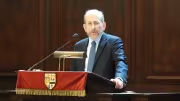
Photograph by Stephanie Mitchell/Harvard News Office

Photograph by Stephanie Mitchell/Harvard News Office

Harvard today announced that it had agreed with the United States Army to establish a limited on-campus presence for an Army Senior Reserve Officers Training Corps (SROTC), with the University assuming the costs of student participation in the program. The Army's professor of military science at MIT will now have office hours on the Harvard campus, and can provide on-site mentoring to cadets.

The agreement follows by a year the agreement to have a Navy ROTC presence on campus, following repeal of the "Don't Ask, Don't Tell" policy that had disqualified openly gay men and women from military service.

As before, the programs will be based at MIT, the armed services' local area campus for such training. At other institutions, such as Yale—which earlier agreed to two military-training programs—the ROTC programs are academically based on that campus (there is no other regional ROTC program nearby), with formal recognition for the military personnel as Yale-affiliated academic instructors.


Related topics

You might also like

The University has pushed the adoption of AI into teaching and operations, but faculty resistance is growing louder.

The division is launching a new fundraising effort to support 50 additional students.

President Alan M. Garber used traditional Memorial Church address to consider the unique qualities of human intelligence and learning.

Most popular

Harvard’s Class of 2029 Reflects Shifts in Racial Makeup After Affirmative Action Ends

International students continue to enroll amid political uncertainty; mandatory SATs lead to a drop in applications.

Harvard Weathers a Year of Turmoil

The federal government has launched unprecedented actions against the University. Here’s a guide.

Lafayette’s Unexpected Gift to George Washington: Pheasants

The two birds will be on display at Harvard this summer.

Explore More From Current Issue

Three actors perform on stage, with one actor interacting closely with another, set against abstract backgrounds.

The play Spare Parts is a contemporary fable about the quest to live forever.

Modern building with large glass windows, surrounded by greenery and pedestrians.

A roundup of University news from the summer of 2026

Caricature of a young man in front of red doors, wearing a green striped sweater.

In 1954, Gregory Corso moved into Eliot House. How he stayed there is a literary legend.