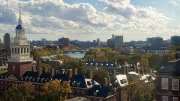
Twenty-five years ago, in the spring of 1988, six alums from the class of 1963 attending their twenty-fifth reunion unearthed a time capsule buried in a corner of the courtyard in front of Eliot House (see John Harvard's Journal, July-August 1988). Later that day, most of them wrote a letter—a prediction—and then buried those in a second time capsule, to be unearthed in 2013.
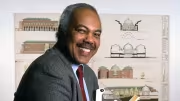
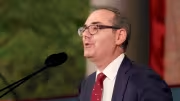
On Wednesday morning of Commencement week, shortly before 9 a.m., four of the six—Tony Rossmann, David Otto, Bruce Johnson, and Paul Bamberg—opened the second capsule in a small conference room in Eliot House. (The group, originally comprised of 12, lived together in Eliot House as students, and call themselves the Thundering Herd.) Missing were Boone Turchi, who was stuck in traffic, and Myles Alexander Walsh III, who died in 2008, but was represented by his son Myles Alexander Walsh IV (Alex), and his grandson, Myles Alexander Walsh V (Xandy).
In the 25 years since the last capsule was opened, at least a few of the friends simply forgot about the second one. An excavation project in the courtyard (nobody was sure when) forced an early retrieval, and it ended up unopened in Myles Walsh’s possession for several years. Alex Walsh found it this spring while going through some of his father’s things, and drove it to Cambridge from his home in Falmouth, Massachusetts.
In the capsule were several photographs, including group shots from the reunion in 1988, but the main attractions were the letters tucked away in a glass bottle (Bamberg didn’t write one). David Otto, a retired research psychologist who worked for the Environmental Protection Agency, read his letter first. A few of his predictions were spot on: Bruce Johnson would retire from tax law and enter politics (technically, he is now a consumer advocate), Boone Turchi would remain at the University of North Carolina as a professor of economics, Tony Rossmann (formerly Cosby-Rossmann) would slightly change his name, again. A few of his other predictions were not so prescient: Rossmann, an environmental lawyer and lecturer at the University of California, Berkeley, isn’t a senator, and Paul Bamberg, senior lecturer in mathematics, hasn’t retired to Oxford—he’s still at Harvard. “But it could still happen!” Rossmann said.
“Tony Crosby-Rossmann seems semi-settled in California,” Johnson read. “Since environmental problems will be worse in 2013, he’ll have plenty of work for the next quarter-century.”
Rossmann, for his part, read with laughter his prediction that the United States was “on the eve of a nonideological but progressive age.”
Xandy Walsh read his grandfather’s letter. “Life is biological triumph,” it declared. The predictions focused on the general: “Harvard will admit equal classes of men and women. Superconductors will prove to be a fad of the 1990s. The price of gasoline will make it too expensive to use as automobile fuel.”
But Walsh, alone among them, had included a second letter. “There is a chance that I will not be able to attend our fiftieth reunion,” it began. “If I do not, I want to thank you for making me what I was, and what I expect to be. My prediction, of a more general nature: I am not as certain about things as I used to be.”