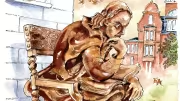
This big boy is Colossus monarchicus statua Danielis, published by Matthaeus Seutter in Augsburg, Germany, in 1730. Sara Schechner describes it as “a timeline of monarchies drawn on a colossal statue of Daniel made of different materials to represent the golden age, silver age, copper age, and so forth down to his feet of clay.”
Schechner, who is Wheatland curator of the Collection of Historical Scientific Instruments, was lead architect of Time & Time Again, an interdisciplinary exploration of what time is, or what answers have been given to that question in various ages by different world cultures and disciplines. The exhibition, in several venues, offers a wide array of time-related objects.
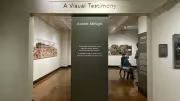
The starting point is the second-floor exhibition gallery of Schechner’s own bailiwick, in the Science Center. The punching sound of a time clock marks each visitor’s entrance into the gallery. Straight ahead is a chicken, to remind explorers of the old conundrum about time, chickens, and eggs: Which came first…?
Gathered here are things from the four parts of Harvard’s Museums of Science and Culture (the Museum of Natural History, the Peabody Museum of Archaeology and Ethnology, the Semitic Museum, and the Historical Scientific Instruments), as well as from other treasure troves, such as the Map Collection (this colossus) and the Schlesinger Library on the History of Women in America (Julia Child’s stopwatch). One may download a free smartphone app that will lead from this gallery, using geo-location, along “time trails” to 40 other objects elsewhere in the Museums of Science and Culture.
Themes include determining time from nature (with trilobites) and timekeeping by human artifice (Schechner’s own museum’s extensive holdings of pocket sundials and pocket-size clocks). Time travelers can examine cultural beliefs about the creation and end of time, the flow of time, and personal time as marked by rites of passage. Here, for instance, is a Bayaka initiation mask, dated 1948, from Africa, that was worn in dances through neighboring villages by a boy of 10 to 14 years celebrating his completion of a year-long “bush school,” which began with his circumcision. And a beaded, turtle-shaped amulet containing a dried umbilical cord, worn by a young Lakota (western Sioux) girl of the late nineteenth to early twentieth century. “Lakota youngsters were called ‘carry your navel’ kids,” says Schechner, “because they wore such umbilical amulets until about age six.”
The exhibition opened in March and runs until December 6. There’s plenty of time left to see it.