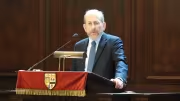
The John D. and Catherine T. MacArthur Foundation conferred its annual $625,000 no-strings-attached fellowships (known as “genius grants”) yesterday. The 21 recipients include professor of mathematics Jacob Lurie and Jennifer Eberhardt, Ph.D. ’93, Joshua Oppenheimer ’97, and Craig Gentry, J.D. ’98.
Lurie, a mathematician who is “creating a conceptual foundation for derived algebraic geometry,” has written two major treatises that redefine “the foundations of homotopy theory and topological aspects of algebraic geometry, showing how many known concepts and results can be recast and improved in the framework of infinity-categories,” according to the MacArthur Foundation’s website. According to a press release about the winners, Lurie is revolutionizing and rewriting whole subfields of math from a new point of view, and the next generation of mathematicians is being trained using his work.
Eberhardt is a social psychologist investigating the largely unconscious yet deeply ingrained ways in which individuals racially code and categorize other people, with a particular focus on associations between race and crime. According to the MacArthur Foundation’s website, “Her studies regarding visual attention and racial bias in modern policing and criminal sentencing offer concrete demonstrations that stereotypic associations between race and crime directly impact how individuals behave and make decisions, often with far-ranging ramifications.”
Oppenheimer is a documentary filmmaker whose Academy Award-nominated 2012 film, The Act of Killing, investigates the massacre of as many as two million Indonesians by the state in the 1960s, and the way the perpetrators continue to live as national heroes today. His new film, The Look of Silence, premiered at this year’s Venice Film Festival to rave reviews. According to the MacArthur Foundation’s website: “Through a unique mode of filmmaking that mixes the real and the invented, he is challenging the modern aesthetic of contemporary documentary cinema in both intimacy of focus and visual construct.”
Gentry, a computer scientist, is revolutionizing our ability to analyze large sets of data while keeping that data private. He has developed a potential model for encryption that could enable the analysis of sensitive encrypted data like healthcare records and financial information. The MacArthur Foundation’s website reports: “Drawing on techniques from mathematics and computer science, Gentry is inspiring not only a flood of practical applications but also opening doors for new intellectual pursuits across the whole of cryptography.”