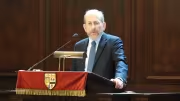
Harvard College grants early admission to class of 2019

As early applications soar, 977 candidates are admitted to the class of 2019.

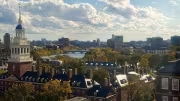
Photograph © Alonso Javier Torres (Alotor)/Flickr/Creative Commons 2.0

Photograph © Alonso Javier Torres (Alotor)/Flickr/Creative Commons 2.0

The College announced today that 977 applicants from a pool of 5,919 had been granted early-action admission to the class of 2019, entering next August. The number of admissions is consistent with last year's level, but the number of applicants soared. In the years since early-action has been reinstituted, 774 of 4,228 applicants were so favored in 2011; 892 of 4,845 applicants in 2012; and 992 of 4,692 in 2013—about 60 percent of a typical class. Such admissions are not binding on applicants, who can decide next spring whether to enroll, but the "yield" (percentage of those offered admission who accept) is typically very high—meaning that the rate of admissions for the many thousands of regular applicants (who of course may also differ in quality from the early applicants) is now extraordinarily low.

Admissions staff attributed the sharp increase in early applications to Harvard College Connection—a Web, video, and social-media outreach and recruiting program that was announced in October 2013. It will be interesting to see whether other early-action institutions also attracted a larger pool, as the competition for a slot at an elite, selective institution continues to intensify, prompting high-school students to submit ever-more applications and to pursue coveted early-admission slots. One possible effect: the early-action pool may become a bit diluted. Harvard probably does not want to admit still more early applicants, a sort of upper bound on December admissions; but this year, it deferred 4,292 for regular-action consideration (March 31 notification) and rejected 541. Other applications were withdrawn or incomplete.
Read the news announcement here.

You might also like

The University has pushed the adoption of AI into teaching and operations, but faculty resistance is growing louder.

The division is launching a new fundraising effort to support 50 additional students.

President Alan M. Garber used traditional Memorial Church address to consider the unique qualities of human intelligence and learning.

Most popular

Harvard’s Class of 2029 Reflects Shifts in Racial Makeup After Affirmative Action Ends

International students continue to enroll amid political uncertainty; mandatory SATs lead to a drop in applications.

All That’s Unseen charts the Harvard graduate’s uneasy journey from Appalachia to Cambridge and back.  

Harvard art historian Jennifer Roberts teaches the value of immersive attention

Teaching students the value of deceleration and immersive attention

Explore More From Current Issue

Three hands hold smartphones displaying social media profiles with likes and hearts.

Tell us about how social media impacts your daily life.

Smiling woman stands beside a large skull in a display cabinet.

From competing in youth gymnastics to studying tetrapods, the Harvard curator has always chased her curiosity.

A busy classroom filled with students working at computers, colorful decor, and a bright atmosphere.

In 2004, a frenzy spread across Harvard Yard in days. Four billion users later, we are only just catching up.