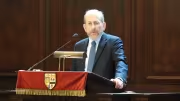
The University has announced that Kenji Yoshino ’91, the Chief Justice Earl Warren professor of constitutional law at New York University School of Law, has been elected president of Harvard’s Board of Overseers for the academic year 2016-2017. Nicole Parent Haughey ’93 has been elected vice chair of the Overseers executive committee for the year.
The elections are a routine matter: annually, two Overseers in the final year of their six-year term are elevated to these posts. (One of Yoshino’s predecessors as president of the board, in 2009-2010, was Merrick Garland ’74, J.D. ’77, chief judge of the U.S. Court of Appeals, District of Columbia Circuit, and current nominee to the U.S. Supreme Court.)
Yoshino’s election creates an interesting coincidence. As a slate of petition candidates for election to the Board of Overseers has alleged discrimination against Asian-American applicants to Harvard (also the subject of pending litigation), and the carefully scrutinized admissions figures for the College’s class of 2020 detail new levels of diversity on several dimensions, three Asian Americans—of Chinese, Japanese, and Korean descent—occupy senior leadership roles at the University:
- William F. Lee ’72, senior fellow of the Harvard Corporation (the senior governing board, to which he was elected in 2010, following previous service as an Overseer);
- Yoshino, incoming president of the Board of Overseers (the elected and advisory governing board); and
- Paul L. Choi ’86, J.D. ’89, current president of the Harvard Alumni Association (to which post he was elected last year, following long service as an elected director and officer of the association).